Vision-guided robotic case packing

One robotic case-packing family.
Configured for your product.

The Osprey is JLS's family of vision-guided robotic case packers — application-matched vision and custom end-of-arm tooling that load sealed trays, chubs, bags, pouches, and thermoformed packs into cases at end of line. Each variant is configured for your product and case format.
One family
Tray, chub, and bag/pouch case packing
2D or 3D vision
Application-matched on every Osprey
VOB 2.0
Vacuum On Board tooling
Cleanable
Construction standard; higher sanitation per application
The Osprey case packing line

A flexible family of vision-guided
robotic case packers.

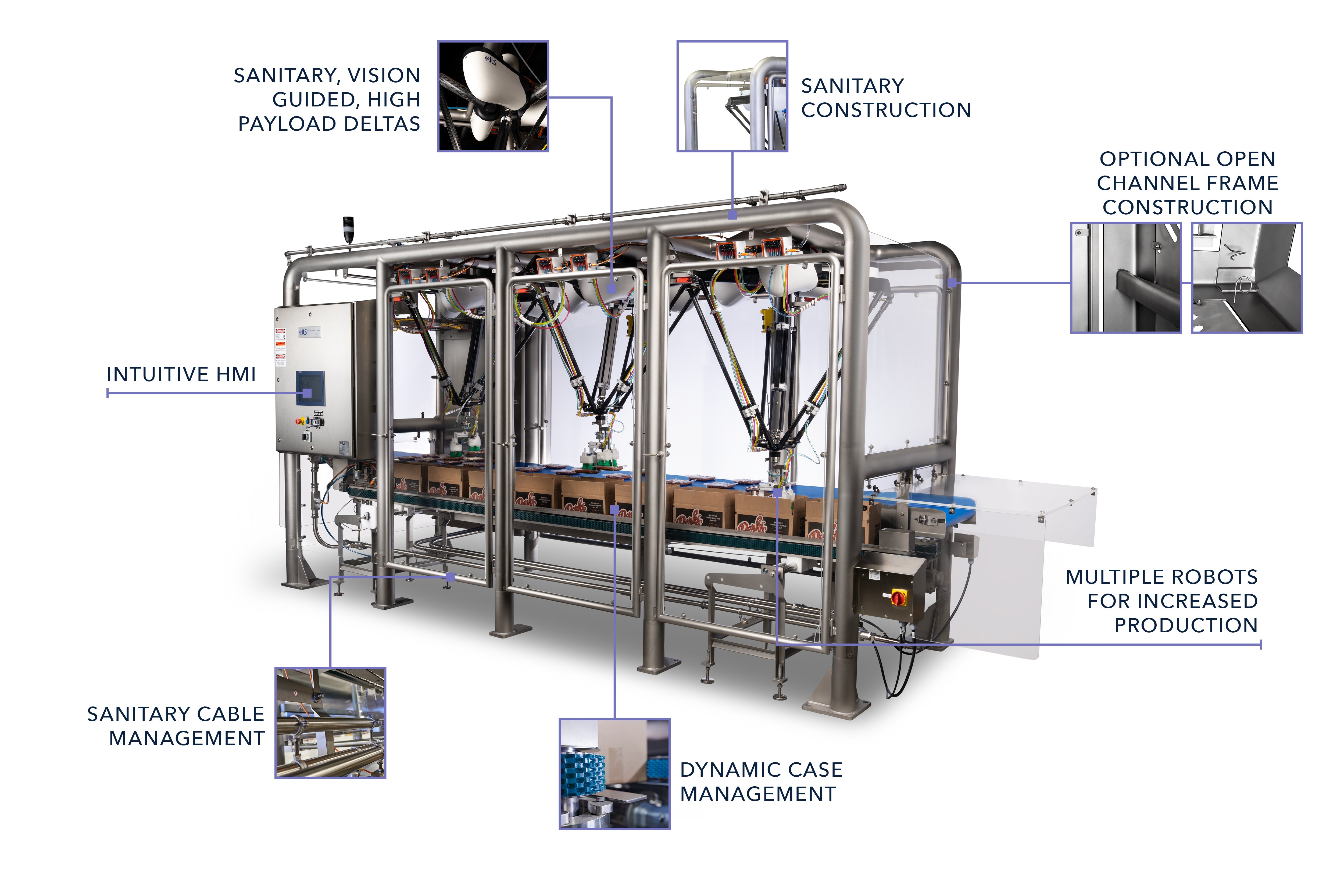
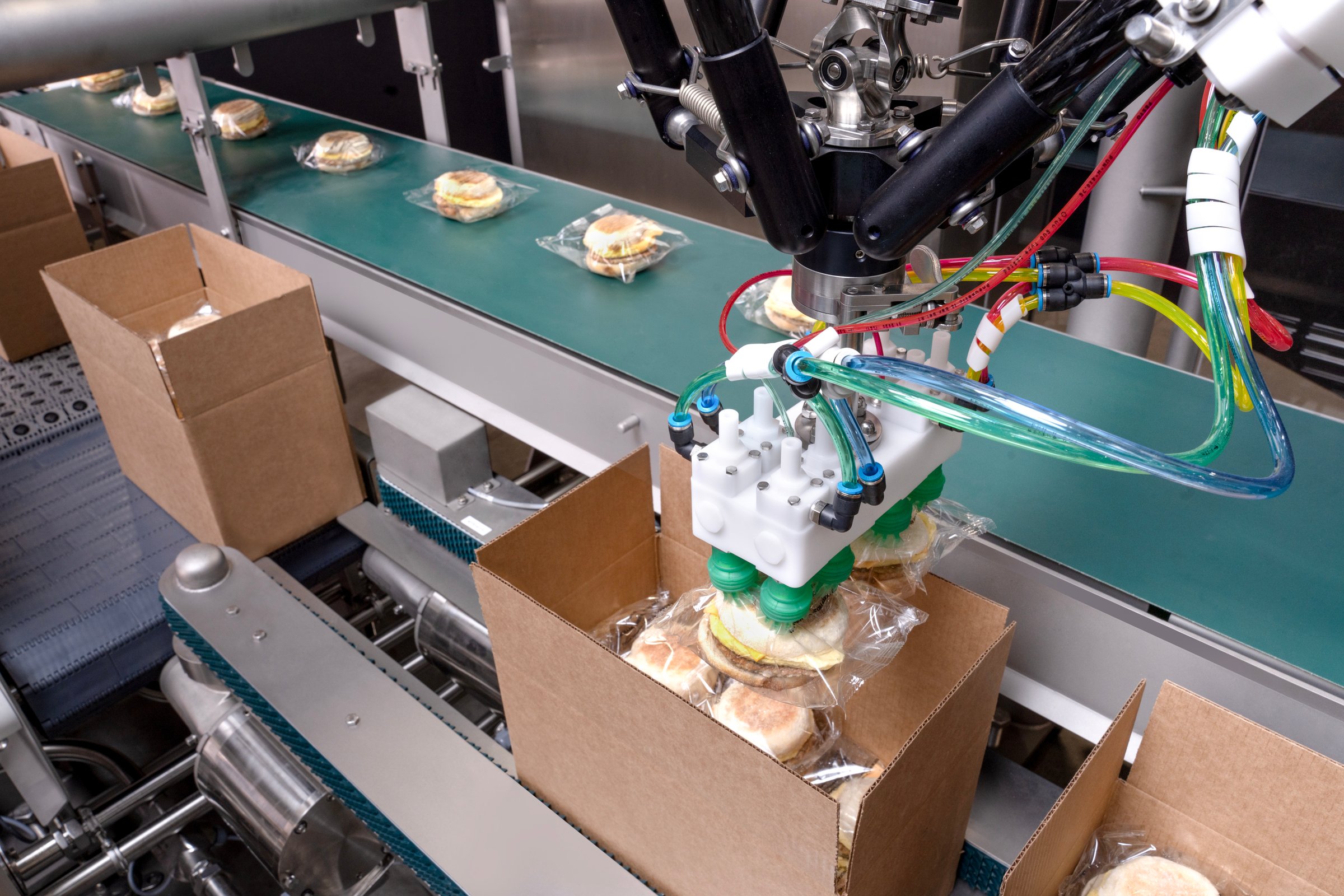
The Osprey is JLS Automation’s family of vision-guided robotic case packers for food manufacturers, built for a wide range of package formats — sealed tray loading, chub loading, and bag, pouch, and thermoformed-pack case packing — with delta robots, application-matched 2D or 3D vision, VOB 2.0 vacuum tooling, and cleanable construction. JLS controls engineers program case-pattern logic, motion, and the HMI in York, PA, integrating commercially available robots on the B&R controls platform — and after installation, JLS’s in-house support team has direct access to JLS engineering and programming expertise. Choose the variant for your package format below.

JLS Osprey vision-guided robotic case packer loading finished food trays into a shipping case with a cleanable-construction delta robot
Applications

Built for the package formats food plants run.

The Osprey case packs sealed trays, chubs, bags, pouches, and thermoformed packs of meat, poultry, dairy, prepared foods, pet food, and more — with tooling configured for your exact package, weight, and line speed.

Sealed trays — Osprey TL

MAP trays · VSP trays · Foam trays · Flow-wrapped trays · Sleeved and lidded trays · Prepared-meal trays

Chubs — Osprey CL

Ground beef, pork, turkey, and chicken chubs · Sausage chubs · Pet food chubs · Dough and spread chubs · 8 oz–10 lb

Bags & pouches — Osprey BP

Stand-up pouches · Pillow bags · Flow-wrapped bags · Foodservice bags · Vacuum pouches

Thermoformed & flat packs — Osprey BP

Thermoformed flexible packs · VSP packs · Brick packs · Flat pouches
Don't see your product? Talk to an engineer

Choose your Osprey.

Three case-packing configurations in one proven family — every Osprey is vision-guided and runs recipe-driven changeovers from the HMI. Pick the variant configured for your package format and have the tooling customized for your exact product and line speed.
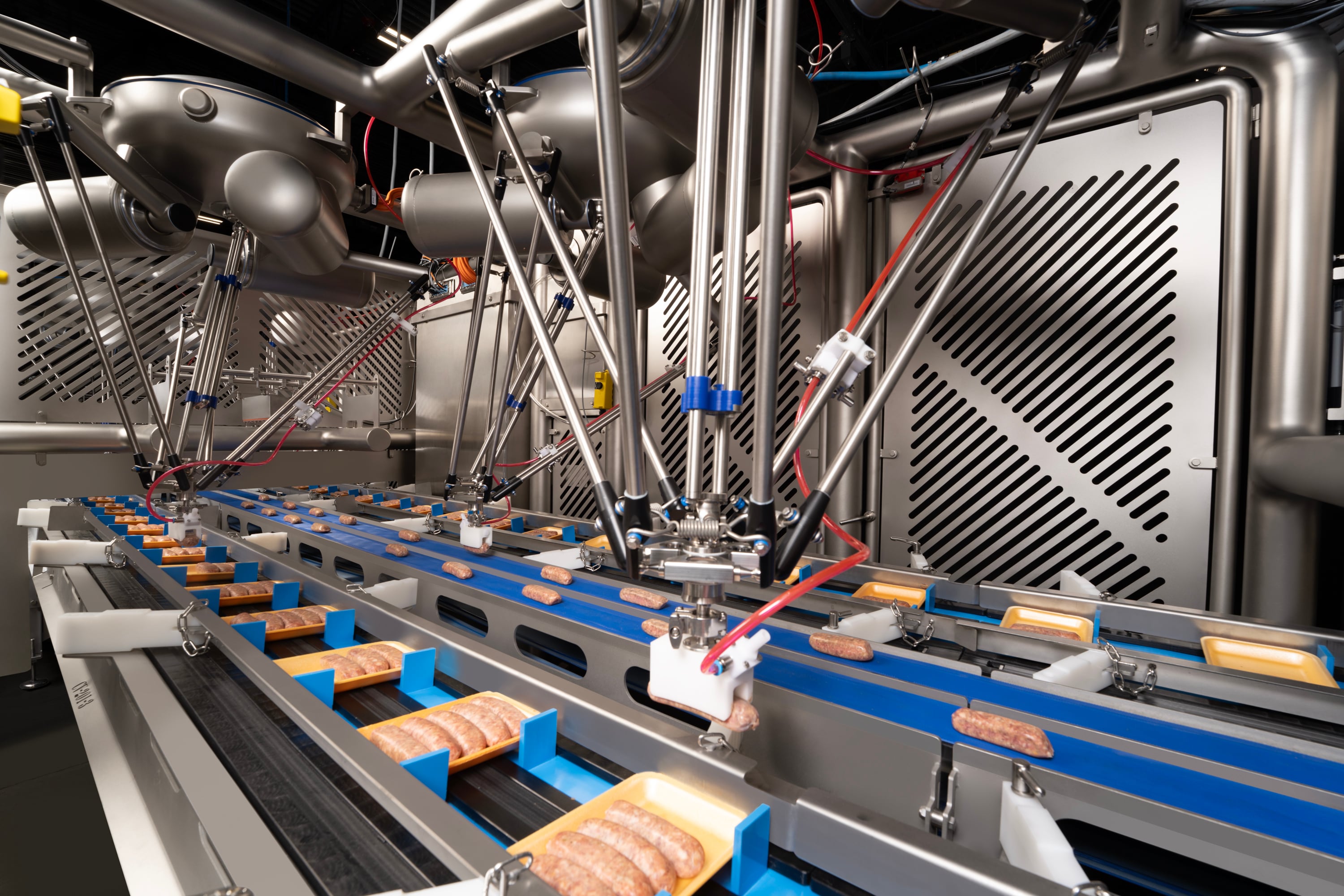
Osprey TL robotic tray loader packing meat trays into cases

Osprey TL

Rigid & semi-rigid tray loading

Rigid and semi-rigid sealed trays — MAP, VSP, foam, and flow-wrapped — loaded into cases with vision-guided placement at up to 180 trays/min in a Tri Head (three-head) configuration, application-dependent.

Best for: MAP trays, VSP trays, foam trays, flow-wrapped trays, and sleeved or lidded tray formats.

Key advantage: Custom VOB 2.0 tooling configured for your exact tray geometry. Small footprint fits tight plant layouts. Cleanable construction as standard; higher-sanitation configurations with IP69K-rated components can be engineered where the application requires them (IP69K rates selected components, not the complete machine).
Up to 180 trays/min (Tri Head)Cleanable ConstructionVOB 2.0 ToolingApplication-Matched Vision
Explore Osprey TL
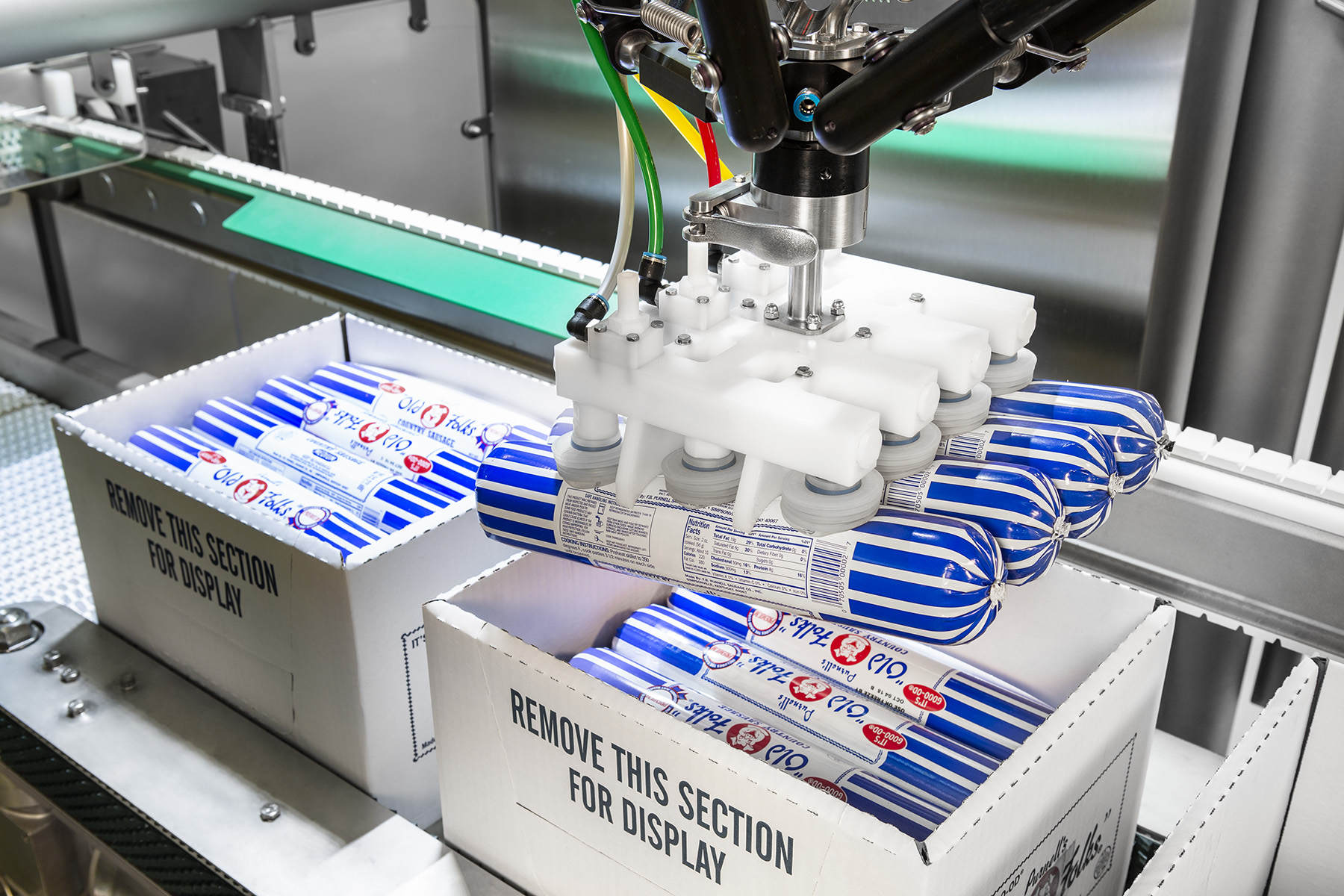
Osprey CL robotic chub loader using V-TRACK conveyor to load sausage chubs into a case

Osprey CL

Chub & cylindrical product loading

Chubs loaded into cases at up to 240 chubs/min, depending on chub size, weight, pack pattern, and system configuration. The V-TRACK pick conveyor holds each chub in line and prevents rolling.

Best for: Ground meat chubs, sausage chubs, pet food chubs, and other chub formats from 8 oz to 10 lb.

Key advantage: The V-TRACK conveyor cradles each chub — solving the rolling problem that keeps chub packing manual. VOB tooling is engineered to accommodate chub variation within the specified application.

Up to 240 chubs/min by configurationCleanable ConstructionV-TRACK ConveyorVOB Tooling
Explore Osprey CL
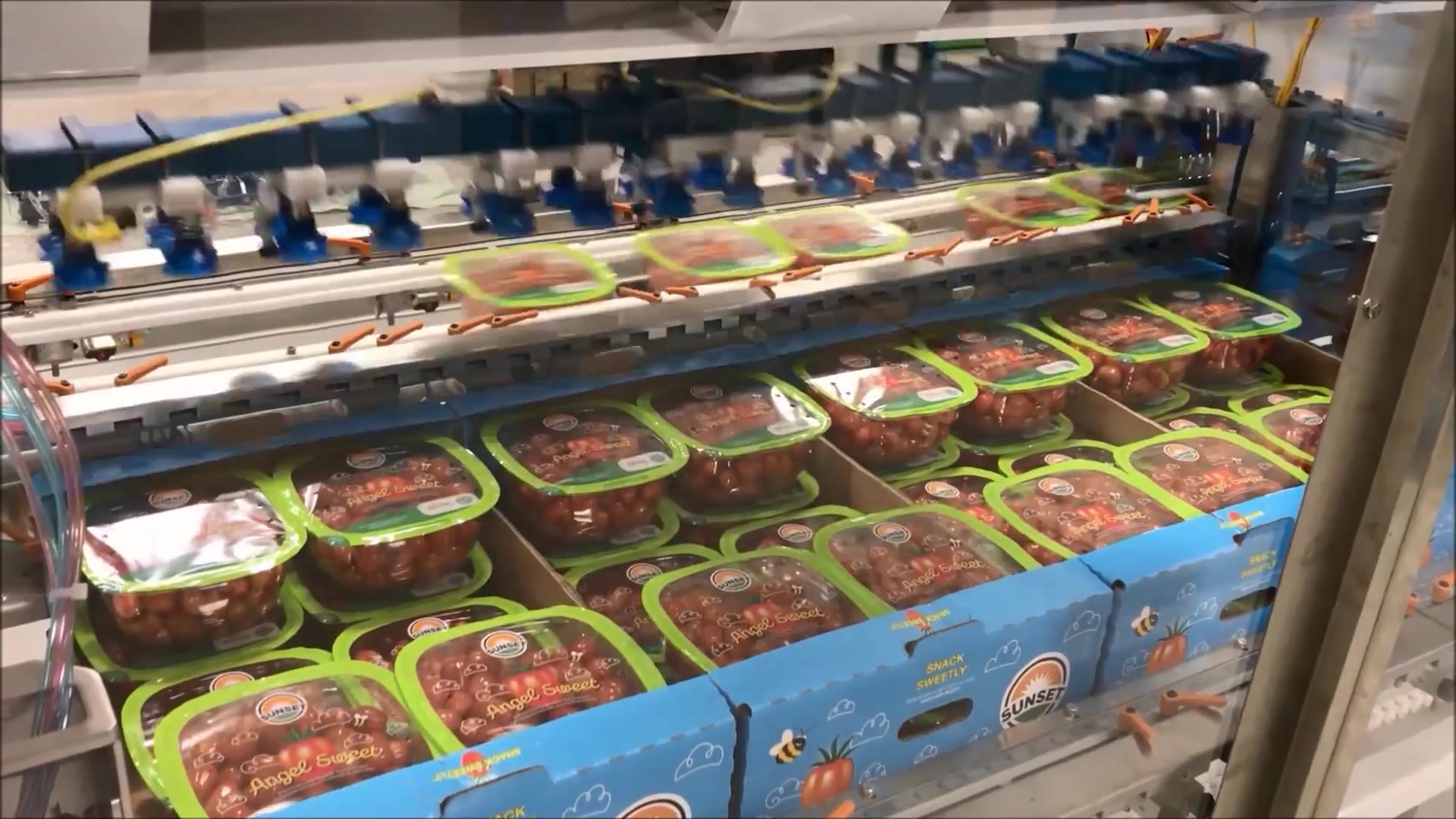
Osprey BP robot loading flexible pouches into a shipping case

Osprey BP

Bag, pouch & thermoformed-pack loading

Unsupported flexible packages — pouches, bags, vacuum packs, brick packs, and thermoformed packs — loaded gently and precisely with custom VOB 2.0 tooling.

Best for: Pillow bags, stand-up pouches, vacuum packs, thermoformed flexible packs, brick packs, and flow-wrapped products.

Key advantage: Application-matched 2D or 3D vision locates each flexible pack within the presentation window, and VOB 2.0 tooling is configured for soft, deformable packages.

Application-Matched 2D or 3D VisionCleanable ConstructionVOB 2.0 Tooling
Explore Osprey BP

More JLS solutions for case packing.

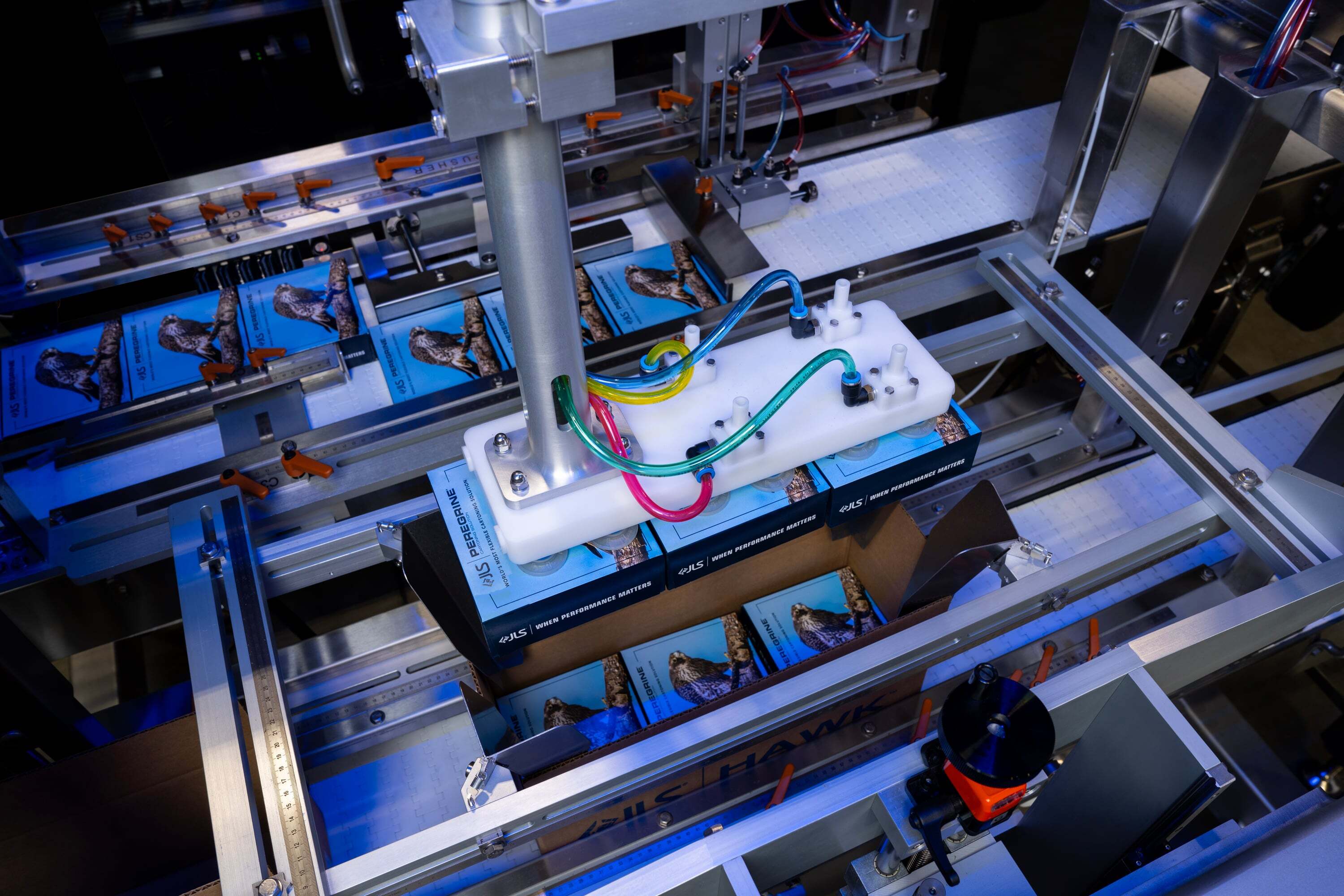
Hawk 2-axis robotic case loader packing products into cartons

Hawk

Small-footprint case & tray loading

Compact, sensor-based case packer built on a proprietary 2-axis kinematic robot arm for consistently presented cartons, trays, clamshells, and other rigid containers — handling up to 220+ cartons per minute, with completed-case rates that depend on products per case and configuration. Small footprint, cleanable construction, IP65-rated components.

IP65-rated ComponentsSmall FootprintCleanable Construction
Explore the Hawk
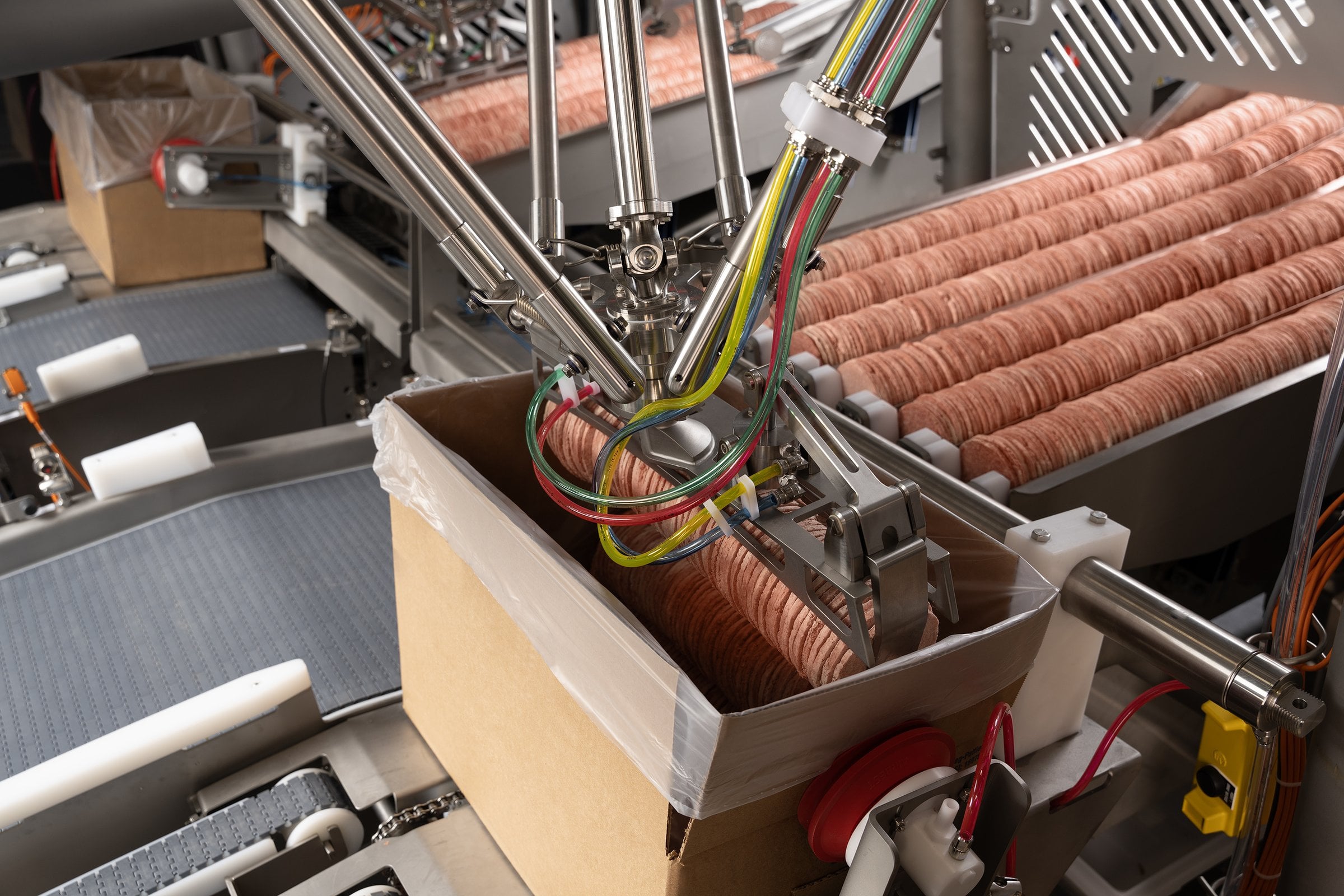
Patty Hawk robot stacking frozen patties into a case

Patty Hawk

Frozen patty case packing

Purpose-built robotic case packing of frozen IQF hamburger patty stacks — picks pre-formed stacks into cases; other round patty formats reviewed per application. Full-washdown construction with an IP69K-rated delta robot.

IP69K-rated Delta RobotFull WashdownProtein-Optimized
Explore Patty Hawk
Platform Engineering

Case packing automation designed for food.
Not adapted to it.

Most pick-and-place robots start life in automotive or electronics — then get modified for food. The Osprey was engineered from the ground up for high-speed food case packing, with cleanable construction as standard and higher-sanitation configurations engineered where the application requires them.
Vision system

Application-matched vision, built into the controls

Every Osprey is vision-guided, with application-matched 2D or 3D vision integrated into the JLS controls. The camera locates each package on the belt — its position and, where the application needs it, its orientation — and feeds that data to the robot in real time. Vision accommodates product-position variation within the engineered presentation window, so packages don’t have to arrive perfectly aligned. (For product that arrives touching or overlapping, see JLS Vision AI.)

Why it matters: Food production is never perfectly consistent. Application-matched vision lets the Osprey handle real-world variation in package position, within the presentation guidelines JLS sets for your line.
JLS-engineered tooling

VOB™ 2.0 — Vacuum On Board

JLS VOB™ 2.0 Vacuum On Board tooling puts the vacuum generator directly on the robot arm. The VOB 2.0 airflow design was optimized using computational fluid dynamics (CFD) through a partnership with Penn State. Tooling is custom-configured for your exact package: size, weight, texture, and format.

Why it matters: Tooling built around your package supports secure, consistent picks at production speed — and onboard vacuum simplifies plumbing and cleaning.
Cleanable design

Cleanable construction — built for the case-packing room

Round-tube stainless steel frame, continuous welds, sloped surfaces, and minimal horizontal pooling points. Standard Osprey construction is cleanable, built for the cleaning practices of secondary-packaging areas rather than high-pressure, high-temperature washdown. Where an application requires higher sanitation, JLS can engineer a configuration with IP69K-rated components.¹

Built for USDA/FSIS-inspected plants: The Osprey isn't a general-purpose robot with food-grade modifications. It was built for this environment from the first weld.
In-house programming

JLS-programmed motion control

JLS controls engineers program case-pattern logic, motion, and the HMI in York, PA, integrating commercially available robots on the B&R controls platform. Operators select a validated product recipe on the HMI — normal production operation and recipe selection don’t require robot-programming expertise. Depending on the application, a changeover can also include tooling, conveyor-width, or guide adjustments. After installation, JLS’s in-house support team has direct access to JLS engineering and programming expertise, remotely or on-site.

In-house programming: JLS programs the system in-house, so the pack pattern, recipes, and controls logic stay with the people who know them. For the JLS scope, one call reaches a support team backed by direct access to JLS engineering and controls expertise.

Which Osprey is right for you?

Quick side-by-side. Rates are application-dependent — package size, weight, presentation, case pattern, and head count all affect throughput. Click any column heading to see the full product page.

Osprey TL Osprey CL Osprey BP
Best For Rigid & semi-rigid sealed trays — MAP, VSP, foam & flow-wrappedChubs — ground meat, sausage & pet foodUnsupported flexible packages — bags, pouches, brick packs & thermoformed packs
Speed Up to 80 / 140 / 180 trays/min (Single / Dual / Tri Head), application-dependentUp to 240 chubs/min, depending on chub size, weight, pack pattern, and system configurationPackages/min confirmed per application
Changeover Recipe-driven on the HMI; tooling or conveyor adjustments as the application requiresRecipe-driven on the HMI; tooling or conveyor adjustments as the application requiresRecipe-driven on the HMI; tooling or conveyor adjustments as the application requires
Sanitation Cleanable construction; NEMA 4X-rated control enclosures; higher-sanitation options per applicationCleanable construction; NEMA 4X-rated control enclosures; higher-sanitation options per applicationCleanable construction; enclosure ratings confirmed per configuration; higher-sanitation options per application

Find the configuration that fits your product and package — we engineer it for your exact application.

Contact us about your automation needs

See it run

Watch the Osprey in action.

Osprey — cleanable-construction robotic case packing JLS Osprey

Osprey — cleanable-construction robotic case packing

A look at JLS robotic packaging across a range of food formats.

Test before you commit

Prove your case-packing application
before you commit to the line.

Where application testing is appropriate, JLS Flight Lab puts your case-packing application on real JLS robotics in York, PA. Send product samples — or a close proxy, subject to project scope and availability — and JLS application engineers test tooling, pick method, and pack pattern for your package format, so feasibility is established before the design is finalized. Rate and performance are validated during FAT on your system, with final confirmation at commissioning where upstream conditions can’t be simulated. What JLS learns in the Flight Lab feeds directly into production-system engineering and validation — same building, same team.

Feasibility
Tooling & pick method tested
U.S. Built
U.S. built automation
Pre-sale
Application testing, subject to availability
Schedule a Flight Lab Test
They do what they say they’re going to do, and they perform. I would, in a heartbeat, recommend them to any processing facility.
John Buckley, Director of Operations Berks Packing · JLS Osprey Case Packing

Common questions about the Osprey platform.

Common questions about Osprey formats, sanitation, integration, testing, and ROI.

The Osprey is JLS Automation’s family of robotic case packers for food manufacturers. It picks finished packages — sealed trays, chubs, bags, pouches, brick packs, and thermoformed packs — and loads them into shipping cases, including bag-lined cases, at line speed with consistent placement. Three configurations (TL, CL, BP) cover a wide range of food packaging formats, from sealed trays to flexible pouches to chubs.

The Osprey TL is a robotic tray loader for rigid and semi-rigid sealed trays — MAP, VSP, foam, and flow-wrapped. The Osprey CL is a chub loader for ground meat, sausage, and pet food chubs, with the V-TRACK pick conveyor that prevents rolling. The Osprey BP loads unsupported flexible packages — flat pouches, bags, brick packs, and thermoformed packs. Every Osprey uses application-matched 2D or 3D vision. JLS configures the right variant for your package format and line speed.

It depends on what you run: sealed rigid and semi-rigid trays point to the Osprey TL, chubs to the Osprey CL, and bags, pouches, brick packs, or thermoformed packs to the Osprey BP. JLS reviews your product, pack format, and line speed to recommend the right configuration. If you’re unsure, JLS Flight Lab testing with product samples or a close proxy, subject to scope and availability, can establish the pick method before the design is finalized.

Standard Osprey systems use cleanable construction built for food plants — a round-tube stainless steel frame, sloped surfaces, continuous welds, and sanitary cable management, suited to the cleaning practices of the case-packing room, with NEMA 4X-rated control enclosures on the Osprey TL and CL. Standard Osprey construction is not intended for high-pressure, high-temperature washdown. Where an application requires higher sanitation, JLS can engineer a configuration with IP69K-rated components.1

Throughput depends on product and format. The Osprey CL case packs ground meat and sausage chubs at up to 240 chubs/min, depending on chub size, weight, pack pattern, and system configuration. The Osprey TL handles rigid and semi-rigid sealed trays at up to 80, 140, or 180 trays/min in Single Head, Dual Head, and Tri Head (three-head) configurations. Osprey BP rates depend on the package, case pattern, and configuration and are confirmed per application. Head count alone doesn’t set the rate — package size, weight, presentation, and case pattern all matter, and JLS sizes the system to your specific line speed.

It depends on line speed and shift schedule, but an Osprey case packer automates repetitive case-packing tasks that have become increasingly difficult to staff and runs them consistently across every shift, while improving case quality, ergonomics, and throughput. Labor savings scale with line speed, shift schedule, and labor model — a JLS line assessment reviews your line, staffing, and application to help frame the business case.

Yes, through agreed interfaces. The Osprey takes sealed primary packages from upstream equipment such as tray sealers, thermoformers, conveyors, checkweighers, and metal detectors, and hands loaded cases to downstream case closing and sealing. JLS coordinates the mechanical interface, controls communication (line handshake), and timing with adjacent equipment for its defined scope — the third-party machines keep their own controls. You provide the line layout and equipment specs.

Often, yes. In the JLS Flight Lab, JLS application engineers can test your product samples — or a close proxy, subject to project scope and availability — with tooling configured for them, establishing feasibility for tooling, pick method, and pack pattern before the design is finalized. Rate and performance are validated during FAT on your system, with final confirmation at commissioning where upstream conditions can’t be simulated. What JLS learns in the Flight Lab feeds directly into production-system engineering and validation — same building, same team.

Often, yes. The final design depends on available floor space, line speed, product presentation, controls, sanitation access, and your existing equipment. JLS reviews the full line layout so the Osprey integrates the way the plant already runs.

Most JLS Osprey projects evaluate payback in the 24–36 month range, depending on labor cost, shift schedule, line speed, uptime improvement, and the specific application. Labor savings scale with the platform, line speed, and labor model, with added value from improved throughput and more consistent case packing.

Engineered, assembled, programmed, and tested at JLS Automation in York, Pennsylvania — using commercially available robots on the B&R controls platform — with support from JLS's in-house support team, with direct access to JLS engineering and programming expertise — remote diagnostics, on-site service, training, parts, and preventive maintenance. In-house programming means JLS can push updates and troubleshoot without third-party contractors or overseas lag.

Talk to an automation expert

Have a package you need case packed?

Tell us about the package, the case, and what you’re trying to improve. A few sentences is enough.

Prefer to talk? Call (717) 505-3800.

By submitting, you agree that JLS Automation may contact you about your inquiry. See our privacy policy.

1 IP69K refers to the ingress-protection rating of selected components (robots, motors, enclosures) specified for an application — not a rating of the complete machine. JLS cleanable construction: round-tube stainless steel frame, sloped surfaces, continuous welds, and sanitary cable management; NEMA 4X-rated control enclosures on the Osprey TL and CL.

Over 1,000 custom installs. Predictable performance. Premier, dedicated service.

  • Factory-tested reliability
  • In-house programming — York, PA
  • In-house support team, backed by direct access to JLS engineering and controls expertise
  • Fast dispatch from York, PA — within a day's drive of most East Coast and Midwest plants
  • Remote diagnostics + on-site support

Not sure which Osprey fits your line?

Our engineers will assess your product, your package format, and your line speed — then recommend the right configuration.

Have a product you need loaded, packed or cartoned?
Start with whether it’s a fit — not with a quote.
Tell an application engineer what you’re packaging and what the line looks like today. A few sentences is enough. If the product suits it, JLS can test it in the Flight Lab before any design is finalized.
Already running a JLS line?
Connect with the service experts who keep your automation performing.
Spare parts, preventive maintenance, retooling, training, and on-site support — from JLS's in-house support team, backed by direct access to JLS engineering and controls expertise.