/JLS%C2%AE_MasterLogo_Navy.png)
 3 Signs Your Tray Sealing Line Has Outgrown Manual Case Packing">
Your tray sealer doesn't wait. It runs at rated speed, producing sealed trays at a pace set by your thermoformer and upstream processing. The only thing between that output and a loaded case is the crew standing at the end of the line.
For a lot of operations, that arrangement worked well enough — for a while. But there's a point where manual case packing stops being a viable strategy and starts holding the entire line back. Here are three signs you've reached that point.
1. Your tray sealer outruns your packers
This is the most obvious indicator, and it shows up in a number worth measuring if you aren't tracking it already: actual throughput versus rated capacity.
If your thermoformer and tray sealer are rated for a given speed but your line consistently runs well below it, measure where the constraint actually is — in many tray operations it turns out to be the packing station. Manual case packing has a ceiling: the speed at which workers can reliably pick up sealed trays, orient them correctly, and place them into cases without damaging the product or the seal.
That ceiling drops throughout a shift as fatigue sets in. It drops further on second and third shifts when staffing is thinner. And it drops when you're running heavier or larger tray formats that are harder to handle by hand.
The equipment upstream was designed to run faster than your people can pack. That's not a criticism of your crew — it's a fundamental mismatch between automated production and manual packing.
2. You're seeing more seal damage from manual handling
Seal integrity on MAP trays, vacuum skin packs, and lidded trays is non-negotiable. A compromised seal means lost atmosphere, reduced shelf life, and potential product returns. Every time a worker handles a sealed tray — gripping it, rotating it, placing it in the case — there's a chance of seal contact and seal damage.
When throughput pressure increases, seal damage can increase with it. Workers move faster, grip less precisely, and stack less carefully. The result shows up in your quality data: rising reject rates at the end of the line or, worse, seal failures discovered downstream at the distribution center or retail level.
If your seal-related rejects have been trending upward and your tray sealer is performing to spec, look at the packing station. Manual handling at production speed is a frequent source of post-seal damage in tray packaging operations.
3. You can't staff the packing station reliably
This factor has pushed many operations toward automation in recent years. The labor market for repetitive, physically demanding food packaging work has fundamentally shifted. Finding, training, and retaining case packers — especially for cold environments, second/third shifts, and seasonal peaks — is harder and more expensive than it's ever been.
When you can't staff the packing station, the line doesn't run at capacity. When you bring in temporary workers, quality and throughput both suffer during the training period. When experienced packers leave, you restart the cycle.
The comparison is worth running with your own numbers: the fully loaded cost of manual packing includes hourly wages, benefits, turnover costs (recruiting, onboarding, training), overtime during short-staffed periods, workers' compensation exposure, and the production losses during staffing gaps. For many tray packaging operations, that total makes the automation conversation worth having.
What changes with automation
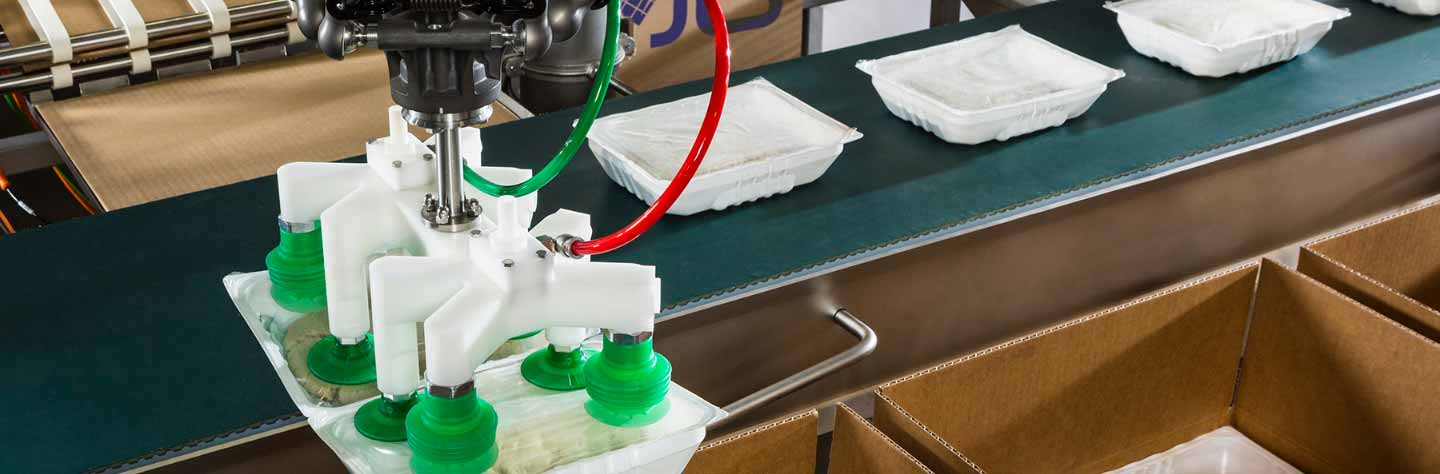
The OSPREY® TL automates the case packing step for sealed tray formats — MAP, sleeved, vacuum skin pack, and lidded trays. High-payload delta robots with vision-guided placement handle trays at production speed without contacting the seal zone. The system is configured and validated to keep pace with your tray sealer's output and runs consistently across all shifts.
Changeover between tray formats is recipe-driven from the HMI. The system is built with cleanable stainless construction, and washdown protection ratings are scoped to the components and configuration selected for your environment. The Osprey TL integrates with all major thermoformer and tray sealer brands, and JLS programs and supports the application controls on commercially available B&R technology — the same platform used across the JLS product family.
None of this means you eliminate people from your packaging operation. It means you redeploy them from a repetitive, injury-prone, hard-to-staff station to higher-value roles — quality assurance, equipment monitoring, upstream processing — where their skills and attention matter more.
The timing question
If one of these signs describes your operation, the case for automation is building. If all three do, it's worth a serious evaluation — the only question is timing.
Talk to a JLS Application Engineer About Your Tray Line
JLS Automation designs and builds hygienic robotic tray loading systems in York, Pennsylvania. To discuss your tray packing application, visit jlsautomation.com/osprey or call +1 (717) 505-3800.
What do you want to know?
By submitting, you agree that JLS Automation and Robert Reiser & Co. may contact you about your inquiry.
Reviewed by
JLS Automation Engineering — York, PA
See it run on your product.
Bring us your product. We'll test it in our York, PA lab and prove the automation before you commit.
Schedule a facility tour