Your Product · Bacon

Bacon breaks ordinary automation.
So we built something different.

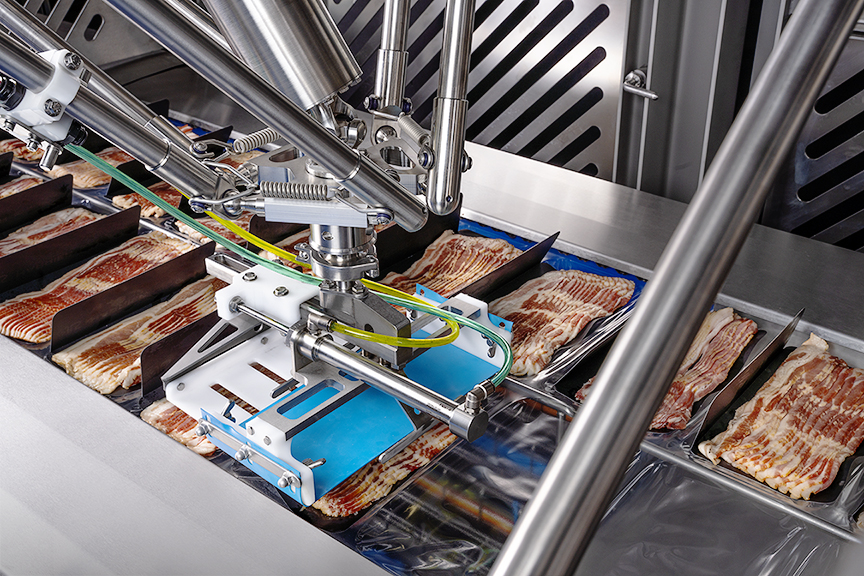
Sliced bacon drafts, thermoformed packs, stand-up pouches, and bacon bits — the Harrier automatically loads fresh sliced bacon drafts into thermoformers, a job that kept bacon lines manual for years. Made to get wet. Built to fit USDA-inspected plants.
Over 70 years
Built on precision, reliability & trust
Multiple
U.S. patents in food packaging automation
Application-matched
Sanitation matched to machine, process & plant zone
U.S. Built
Engineered in-house

JLS builds robotic packaging automation purpose-built for bacon — an air-cylinder-actuated servo finger beneath the Harrier's pick conveyor lifts the sliced bacon draft's L-board flap, and mechanical, cylinder-actuated tooling seats the draft into the thermoformer pocket, an application JLS engineered specifically for bacon. Osprey case-packs thermoformed packs, stand-up pouches, and bacon bits at line speed, with PIVT leak detection guarding every seal. Construction is matched to each station, with IP69K-rated components where specified for washdown, and designed to fit USDA-inspected bacon plants. Every line is engineered, programmed, and supported entirely in-house by JLS.

In action

Watch JLS handle bacon — at full production speed.

Automatic bacon draft loading Bacon Draft

Automatic bacon draft loading

The Harrier loads fresh sliced bacon drafts into thermoformers at full production speed.

Pain points we solve

Bacon’s toughest packaging headaches. Solved.

We’ve spent decades on protein lines. These are the problems bacon processors bring us most — and how JLS robotics solve them.

Sanitation & washdown The challenge

Sanitation & food safety under constant washdown

How JLS solves it
JLS bacon systems can be built with IP69K-rated robots and components, NEMA 4X-rated control enclosures, and open frame stainless, and designed to fit USDA-inspected plants — built for the daily high-pressure washdown these environments require.
Floppy bacon drafts The challenge

Floppy sliced bacon drafts that defy automation

How JLS solves it
An air-cylinder-actuated servo finger beneath the Harrier’s pick conveyor lifts the bacon L-board flap, and mechanical, cylinder-actuated tooling seats the draft into the thermoformer pocket — the draft-loading job that kept bacon lines manual.
Cold, wet cut-room labor The challenge

Labor that’s hard to staff in cold, wet cut rooms
How JLS solves it
Vision-guided robots take over the cold, repetitive packing positions, fill chronic labor gaps, and free your people for higher-value work.
Throughput & line speed The challenge

Throughput & consistency capped by hand-packing

How JLS solves it
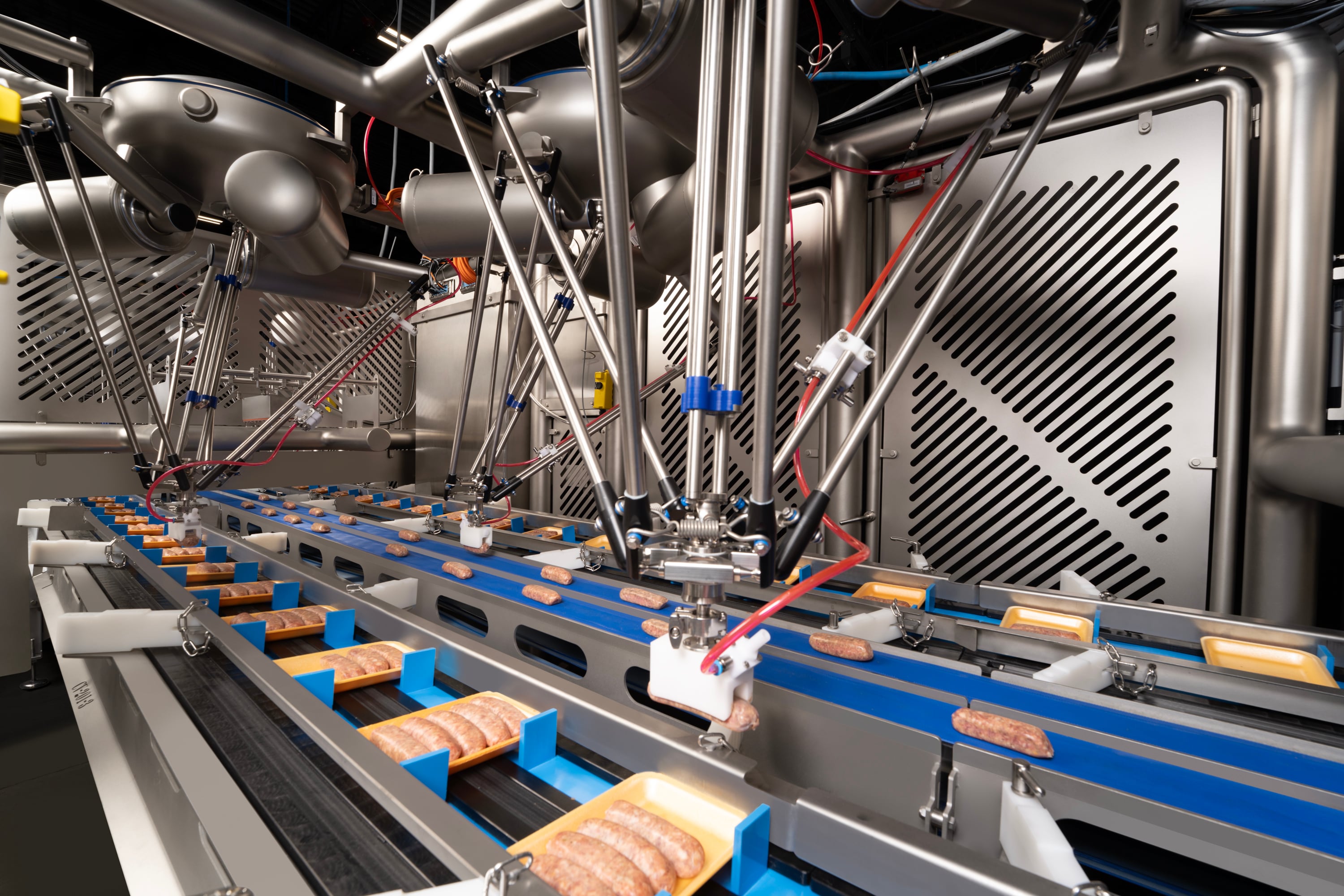
Harrier loads drafts and Osprey case-packs bacon packs, pouches, and bits at line speed — with PIVT leak detection guarding every seal.
Applications

Bacon packaging automation, draft loading to case packing.

From draft loading through case packing, JLS automates every step of a bacon line — with construction matched to each station's sanitation requirements.

Have a custom bacon product?

If it can be sliced, drafted, pouched, or bagged, our engineers have probably packed it — and if not, we’ll figure it out.

Talk to an application engineer

Test before you commit

Send us your bacon.
We'll put it to the test.

Before the design is finalized, send product samples — sliced bacon drafts, bellies, pouches, or bits — or a close proxy, subject to project scope and availability. JLS application engineers test tooling, pick method, and pack pattern to establish feasibility; rate is validated during FAT before shipment, with final commissioning completed at your facility.

Feasibility
Tooling & pick method tested
U.S. Built
York, PA Flight Lab
Pre-sale
Application testing, subject to availability
Schedule a Flight Lab test

Designed to get wet. Built to be cleaned.

In a USDA-inspected bacon plant, sanitation isn't a feature — it's the whole game. Every JLS bacon system is engineered for your plant's sanitation program — with hygienic washdown construction where exposed product requires it and cleanable construction in packaging areas, with IP69K-rated components where the application calls for it — so your line stays compliant and your downtime stays low.

IP69K*
Rated components for washdown
NEMA 4X
Rated control enclosures
USDA
Designed to fit inspected plants
Open-frame
Sloped, minimal harborage

* IP69K refers to the ingress-protection rating of selected components (robots, motors, enclosures) specified for an application — not a rating of the complete machine. Contact JLS for your application.

Bacon packaging automation FAQs.

Common questions about draft loading, sanitation, throughput, ROI, and integration.

Payback is commonly evaluated in the 24–36 month range, depending on labor cost, shift schedule, production volume, uptime improvement, and the specific bacon application. For bacon processors, the business case is often driven by labor savings, reduced manual handling, improved draft presentation, more consistent loading, less rework, better ergonomics, and more predictable packaging performance. Labor savings scale with line speed, labor model, and platform, with additional value from improved throughput and reduced product handling. JLS reviews the draft pattern, package format, line speed, staffing model, sanitation requirements, and current production challenges to help determine where automation can create the strongest return.

Sliced bacon drafts, thermoformed bacon-strip packs, retail stand-up pouches, bulk foodservice bags, pork bellies, and bacon bits — loaded into thermoformers and case-packed flat or vertical.

An air-cylinder-actuated servo finger beneath the Harrier’s pick conveyor lifts the L-board flap, and mechanical, cylinder-actuated tooling then seats the fresh sliced draft into the thermoformer pocket — engineered and lab-tested per product.

Yes, with construction matched to each station. Harrier draft loading can be specified for daily high-pressure, high-temperature washdown with IP69K-rated robots and components; Osprey case packing of sealed packs uses cleanable construction, with higher-sanitation options per application. Open-frame, sloped stainless steel construction is designed to fit USDA-inspected plants.

Yes. JLS integrates with your bacon slicer, thermoformer, and tray sealer, plus your existing upstream and downstream equipment, into one coordinated bacon line.

Yes. JLS PIVT automatic leak detection inspects thermoformed and vacuum bacon packs in-line and rejects leakers before they reach the case — protecting shelf life and reducing returns.

Throughput depends on product and format. The Harrier loads bacon drafts at line speed, and Osprey case rates are sized to your line and SKU mix.

SKUs change via an HMI recipe, and changeover is recipe-driven and application-dependent, with tool-free end-of-arm tooling change where the application allows. Recipes for every purchased, validated SKU are pre-loaded during commissioning before the system ships.

Yes — when the system is designed specifically for bacon handling. Bacon drafts are flexible, slippery, inconsistent, and presentation-sensitive, so the automation has to control the product without disturbing the draft pattern or hurting pack appearance. A properly engineered robotic loading system like the JLS Harrier helps maintain draft presentation, reduce manual handling, and improve consistency from pick to placement.

Bacon drafts are not rigid products. They can slip, separate, distort, or vary in shape depending on temperature, slice quality, fat content, draft pattern, and upstream handling — which makes controlled product presentation and pick accuracy critical. Successful bacon draft automation takes more than a robot: it requires the right product handling, a vision or sensing strategy when needed, custom end-of-arm tooling, conveyor control, sanitation design, and integration with the full packaging line.

Yes. Testing with real product is often a key step in confirming the right handling approach. Bacon varies significantly by slice thickness, draft pattern, temperature, fat content, and presentation, so JLS Flight Lab can test product samples, or a close proxy, subject to project scope and availability, to establish how the product behaves before the system design is finalized — reducing risk. Rate and performance are validated during FAT before shipment, with final commissioning completed at your facility.

Designed, built, programmed, and tested at JLS Automation in York, Pennsylvania. Support comes from JLS's in-house support team, with direct access to JLS engineering and programming expertise — remote diagnostics, on-site service, training, parts support, and preventive maintenance.

Yes. JLS bacon handling systems are designed to fit USDA-inspected plants, with construction matched to your sanitation program — IP69K-rated robots and components where the station calls for daily high-pressure, high-temperature washdown, NEMA 4X-rated control enclosures, and open-frame, sloped stainless steel construction. IP69K refers to the rating of selected components, not the complete machine.

Yes. JLS robotics load bacon drafts and case-pack bacon packs, pouches, and bits on USDA-inspected lines across North America. For each project, JLS reviews the product, packaging format, line speed, sanitation requirements, and production goals to design a system that fits the processor’s actual plant environment.

Still have a question that isn’t answered here?

What do you want to know?

Ask us anything — an automation expert will follow up.

What can we help with? Optional — select any that apply.

By submitting, you agree that JLS Automation and Robert Reiser & Co. may contact you about your inquiry.

Talk to an automation expert

Have a bacon product you need automated?

Tell us what you’re packaging and what you’re trying to solve. A few sentences is enough.

Prefer to talk? Call (717) 505-3800.

By submitting, you agree that JLS Automation may contact you about your inquiry. See our privacy policy.

Ready for the realities of your bacon line?

Bring us your product. We'll test it in our York, PA lab, engineer the automation, and prove the application — before we say yes.

JLS + Reiser: Expertise across the line

Planning a complete bacon line?

JLS engineers the automation for complete bacon lines — from draft loading after the slicer through thermoformer loading, leak detection, and case packing — owning its defined scope and coordinating the agreed interfaces with your slicer, thermoformer, and other equipment suppliers.

Full food production line — JLS + Reiser: expertise across the line Ten production-line stages across four zones. JLS-built robotic automation stages are shown in purple; stages available through Reiser's OEM portfolio in blue; customer-selected or partner equipment in gray. Dashed lines mark coordinated integration points. Prepare. Portion. Form. Load. Seal. Case. Carton. Collate. Stack. Secure. 01Mixing &blendingGrindingEmulsifyingMarinatingTumblingAvailable throughReiser portfolio 02Forming &portioningStuffingExtrudingPatty formingDepositingAvailable throughReiser portfolio 03FurtherprocessingSlicingDicingShreddingTenderizingAvailable throughReiser portfolio 04PrimaryloadingPick & placeVision-guidedLane loadingProduct collationJLS TALONJLS KESTRELJLS Automation 05PrimarypackagingThermoformingTray sealingVacuum / MAPSkin packAvailable throughReiser portfolio 06CasepackingRobotic case loadingRobotic loadingWashdown configurationsWashdown optionsJLS OSPREYHAWK · PATTY HAWKCase erecting & sealing via partner equip.JLS Automation 07CartoningForm, load,close cartonsCompact footprintWashdown-capable designJLS PEREGRINEPEREGRINE ISJLS Automation 08Collation /bundlingCount & stackBundle packMultipackPartner equipmentscope-dependent 09PalletizingLayer buildingRobotic palletizingSlip-sheet placeLayer padPartner equipmentscope-dependent 10LoadsecurementStretch wrapBandingCorner boardTop sheetPartner equipmentscope-dependent Tier 1 Primary Packaging The package that touches the product Tier 2 Secondary Packaging Cases, cartons, and multipacks for retail or distribution Tier 3 Tertiary Packaging Stretch wrap, ship-ready unit

Together, JLS and Reiser help food manufacturers develop coordinated processing and packaging lines—from product preparation and primary package loading and sealing through cartoning and case packing, with third-party collation, palletizing, and load securement coordinated into the plan.

Illustrative line architecture. Stages, equipment suppliers and sequence vary by product and project scope. Not every food line uses every stage, and slicing, cooking, freezing, inspection and other processes may occur in different positions.

Scroll left and right to scan the full line. Open the printable line map →

JLS-built robotic automation Available through Reiser’s OEM portfolio Customer-selected / third-party equipment Coordinated integration point

Reiser role across the line

Food-processing expertise, application development, equipment selection, product testing, and sales & lifecycle support.

JLS role at robotic packaging stages

Robotic engineering, product & package handling, controls interfaces, and integration & FAT when included in project scope.

Let’s talk more about planning your full line.

Tell us who you are and a bit about your line. An automation expert will reach out — and we’ll bring the right people from JLS and Reiser to the conversation.

Your details
Facility location
Your line today
What you're planning
What solution(s) are you interested in?* Select all that apply.
Project timeline

By submitting, you agree that JLS Automation and Robert Reiser & Co. may contact you about your inquiry.

Over 1,000 custom installs. Predictable performance. Premier, dedicated service.

  • Factory-tested reliability
  • In-house programming — York, PA
  • In-house support team, backed by direct access to JLS engineering and controls expertise
  • Fast dispatch from York, PA — within a day's drive of most East Coast and Midwest plants
  • Remote diagnostics + on-site support
Have a product you need loaded, packed or cartoned?
Start with whether it’s a fit — not with a quote.
Tell an application engineer what you’re packaging and what the line looks like today. A few sentences is enough. If the product suits it, JLS can test it in the Flight Lab before any design is finalized.
Already running a JLS line?
Connect with the service experts who keep your automation performing.
Spare parts, preventive maintenance, retooling, training, and on-site support — from JLS's in-house support team, backed by direct access to JLS engineering and controls expertise.