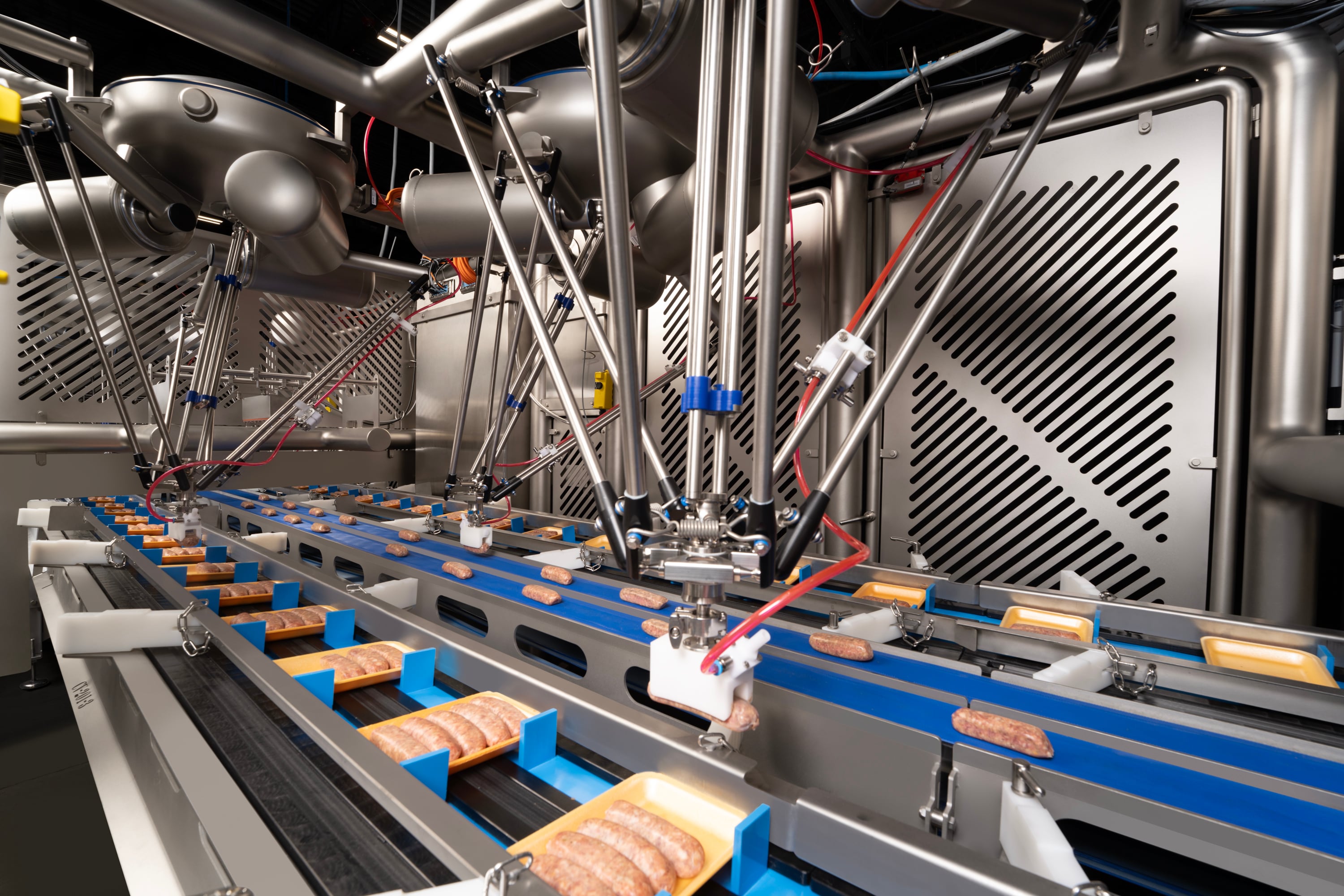
Non-vision robotic case packing with a proprietary two-axis kinematic robot arm

Reliable mechanics. Serious speed.
Hawk keeps case packing moving.

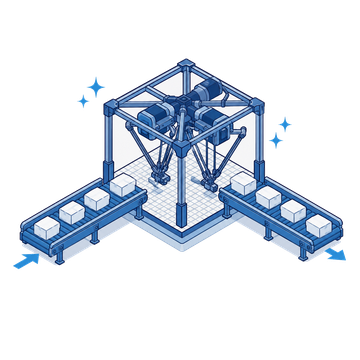
A compact non-vision robotic case packer built for standardized, high-volume secondary packaging — cartons, trays, clamshells, canisters, and other rigid containers. A proprietary two-axis kinematic robot arm with custom VOB 2.0 (Vacuum on Board) tooling. Cleanable construction with IP65-rated components. Engineered, assembled, programmed, and supported by JLS in York, PA.
Up to 220+
Cartons/min handled, by configuration
Sensor-based
Non-vision pick-and-place; no vision calibration
IP65
Rated components; cleanable construction
York, PA
Engineered, assembled & programmed
Multiple PatentsAll in Food Packaging Automation
In-House ProgrammingControls, Vision & Robotics Expertise
Factory-Tested ReliabilityBacked by JLS Service & Support
Installation & SupportDedicated Installation, Startup & Support Team
Delivery Timeline at ProposalTarget delivery scoped to your project
JLS Hawk watercolor bird illustration

The JLS Hawk is a compact robotic case packer built around a proprietary two-axis kinematic robot arm for case packing cartons, trays, clamshells, canisters, and other rigid containers. Sensor-based, fixed-position pick-and-place handles consistently presented product flows, handling up to 220+ cartons per minute, with completed-case rates that depend on products per case and configuration. VOB 2.0 Vacuum on Board tooling configured to your exact product. Cleanable construction with IP65-rated components. Designed, built, and supported by JLS Automation.
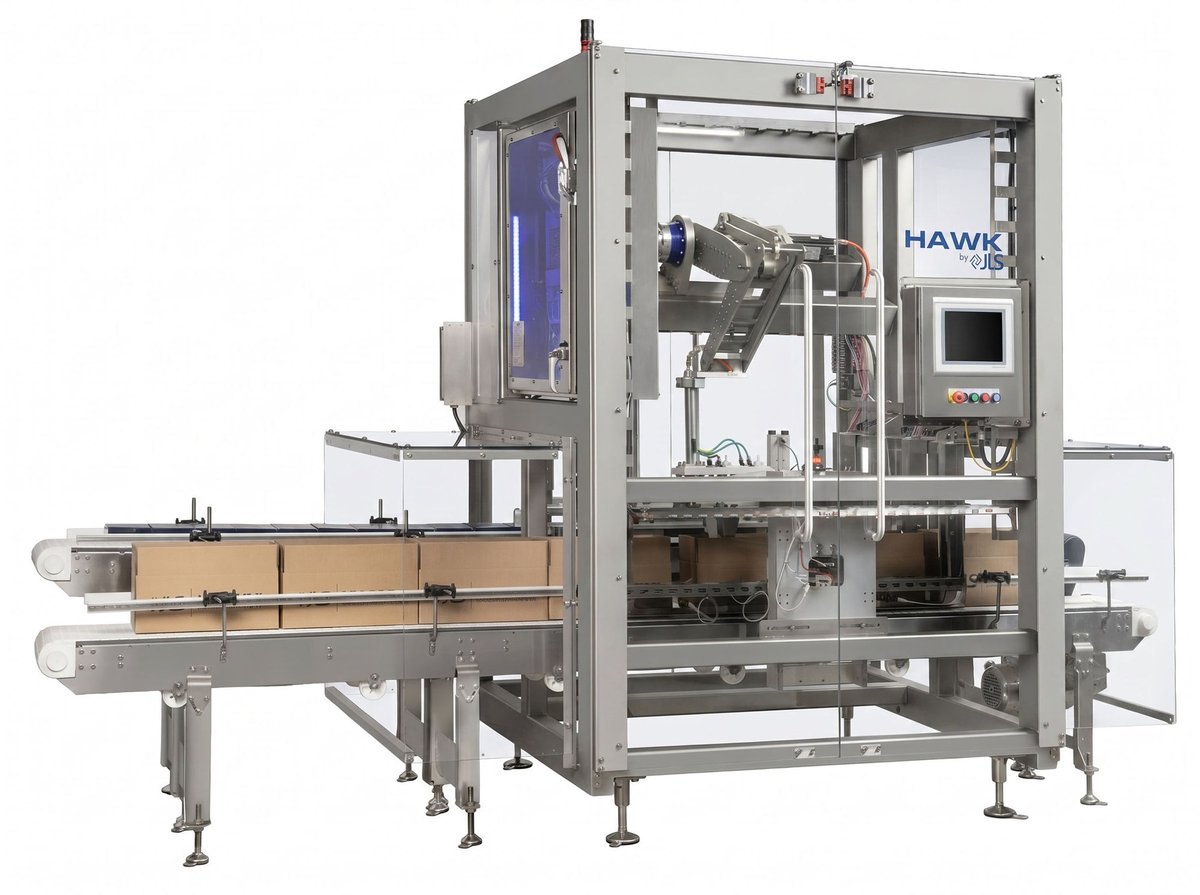
JLS Hawk compact robotic case packer built on a proprietary two-axis kinematic robot arm

In action

Watch it receive, collate, pick, and place —
at full production speed.

Case packing of cartons | JLS Hawk robotic case packer Demonstration

Case packing of cartons | JLS Hawk robotic case packer

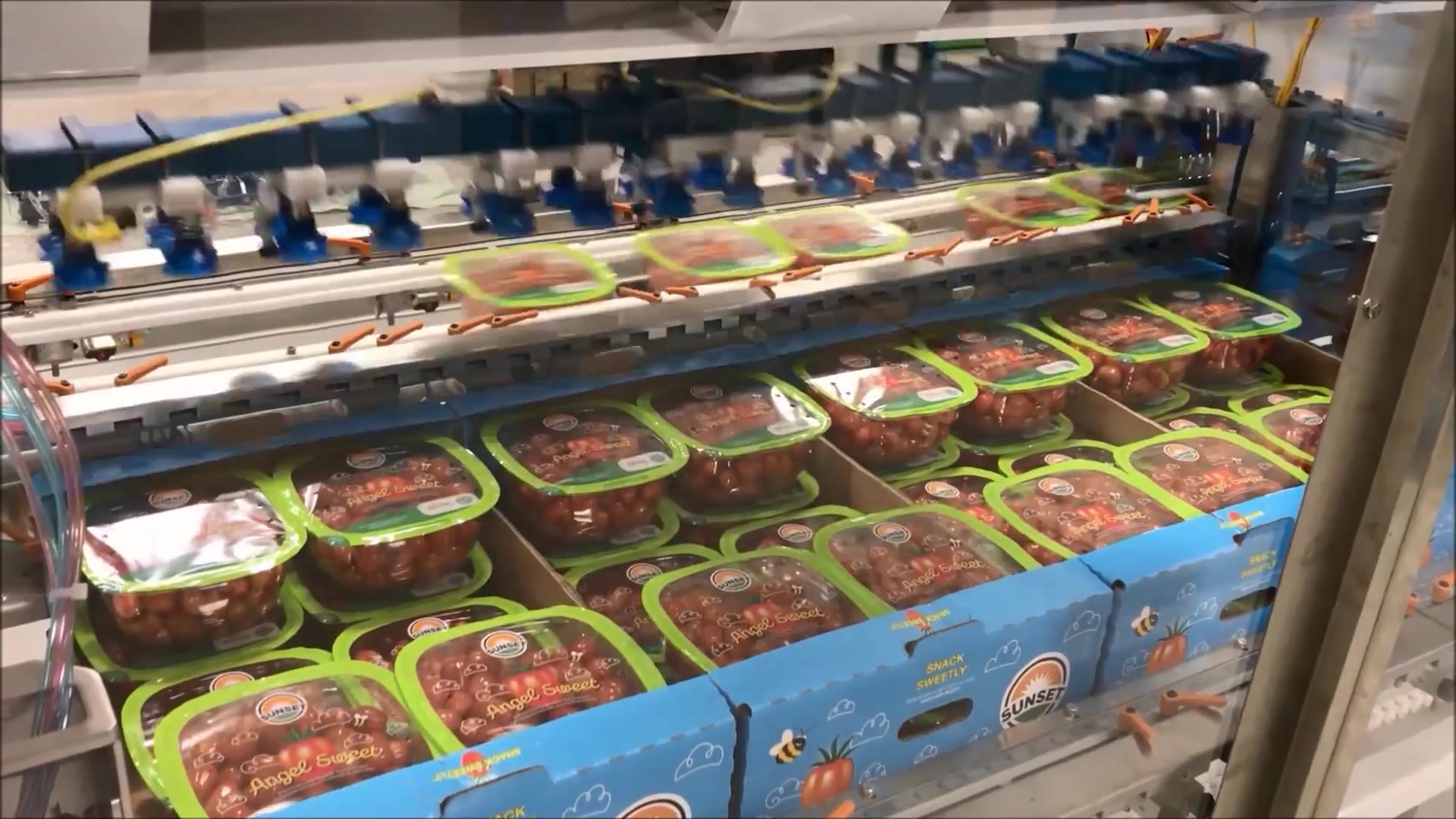
The Hawk compact two-axis robotic case packer loading cartons at production speed. Sensor-based, non-vision design — no vision-system calibration. JLS-engineered VOB 2.0 tooling. Cleanable construction with IP65-rated components.

Why Hawk

Built to keep the case packing station running.

Manual case packing can be one of the most labor-intensive, hard-to-staff steps on the line. When packers can't keep up, throughput drops and labor costs climb. The Hawk was built for that moment — a mechanically simple proprietary two-axis kinematic robot arm with sensor-based, fixed-position pick-and-place that closes the gap between your packaging line and the case.

Where the Hawk fits. The Hawk is well suited to applications with repeatable, controlled product and package presentation, where sensor-based, non-vision robotic case packing is a straightforward and reliable solution. When presentation varies more, JLS’s vision-guided Osprey family is built for that flexibility. Different application needs, one JLS team to match them.

Standardized product in. Consistent case out. Every Hawk is configured around your product, your secondary container format, and your target rate — so one of the most repetitive jobs on the line becomes one of the most predictable.

Applications & Package Types

The Hawk — non-vision robotic case packing.

A robotic case packer that automates standardized secondary packaging for round-the-clock production. Cleanable construction with IP65-rated components. The Hawk uses a proprietary two-axis kinematic robot arm with custom VOB 2.0 food-safe tooling to pick and place cartons, trays, clamshells, canisters, and other rigid containers into cases, handling up to 220+ cartons per minute, with completed-case rates that depend on products per case and configuration. Mechanically simple architecture reduces operator training and maintenance burden. Purpose-built for food. Single-pick or gang-pick VOB 2.0 Vacuum On Board tooling is configured to the package being handled. Built to keep pace with your packaging line, in a high-speed, small-footprint package. Easy to operate.

Industries Served

BakeryCartons, clamshells & trays
Meat & PoultryTrays, cartons & packaged deli meats
Cheese & DairyCartons, tubs & rigid containers
Snack Bars & SticksCartons & multi-packs
ConfectionCartons & display trays
Frozen foodsCartons & trays

Loading Styles & Pack Formats

SingleOne product per placement
Stacked / verticalMulti-count stacks
ShingledOverlapping patterns
Display traysConfirmed per application
Multi-LaneParallel infeed lanes

Related JLS systems

HawkYou’re here
OspreyVision-guided case packing family
Osprey TLTray loading
Osprey BPBags & pouches
Patty HawkFrozen patty case packing

The Challenge

A common end-of-line gap —
and the system built to close it.

✕The Problem

Manual handling at this station is hard to staff — and harder to keep consistent

The same repetitive lifting and placing, every shift — capping throughput and consistency.

Manual case packing is repetitive, physically demanding work that is increasingly difficult to staff, and consistency slips across shifts. When packers fall behind, finished packages back up, case counts and patterns vary, and the line slows. Add turnover, ergonomic strain, and a shrinking labor pool, and the cost of packing by hand keeps climbing.

Chronic
Turnover in manual packing roles
Every shift
Repetitive lifting and placing
Line rate
Throughput manual packing can't sustain
✓The Solution

Engineered robotic automation configured to your exact product

JLS engineers, tests, and installs the system — proven before it ships.

JLS designs the Hawk around your carton, case, and line — the proprietary two-axis robot arm, VOB 2.0 tooling, and controls programming are engineered in-house. Where testing fits the project, JLS Flight Lab evaluates the pick method and pack pattern with product samples or a close proxy before final design; rate and performance are validated during the project FAT, with final confirmation at commissioning where upstream conditions can’t be simulated.

Sensor-based
No vision system to calibrate
Recipe-driven
Changeover, application-dependent
In-house
Controls programming by JLS

Application testing

Prove your Hawk application
in the JLS Flight Lab.

Where application testing fits the project, JLS Flight Lab puts your application on real JLS robotics in York, PA. Send product samples — or we test a close proxy — subject to scope and availability, to establish tooling, pick method, and pack pattern feasibility before the design is finalized. Rate and performance are validated during FAT on your system, with final confirmation at commissioning where upstream conditions can’t be simulated.

Feasibility
Tooling & pick method tested
U.S. Built
U.S. built automation
Pre-sale
Application testing, subject to availability
Test your product in the Flight Lab

Core Technology

The engineering behind the precision.

The Hawk system is engineered, assembled, and programmed under one roof in York, PA — from the cleanable round-tube stainless steel frame to JLS-engineered VOB 2.0 tooling to operator-friendly controls programming, built with commercially available robot, motion, and controls components. Backed by JLS engineering and a portfolio of U.S. patents across JLS food-handling systems, these design choices keep the Hawk mechanically simple — sensor-based pick-and-place, fewer moving parts, less to maintain, and less to train.

Stainless steel construction icon
IP65-rated components

Cleanable construction

Round-tube stainless steel frame (standard), sloped surfaces, and IP65-rated components — cleanable construction for drier secondary-packaging areas. IP65 is a component enclosure rating, not a sanitation level; where an application calls for higher sanitation, JLS recommends its Osprey or Talon platforms. Designed for the food plant from the start, not retrofitted.
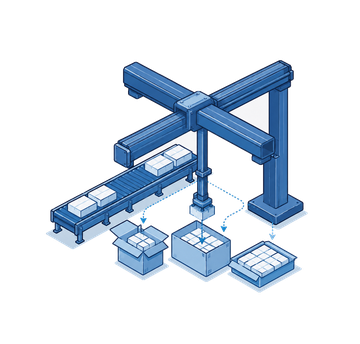
IP65-rated components Sloped Surfaces Round-Tube Frame
Proprietary two-axis kinematic robot arm
Pick · Place · No Vision Calibration

Proprietary two-axis robot arm

JLS's proprietary two-axis kinematic robot arm picks and places product from a standardized, consistent infeed into cartons, cases, and trays — using sensor-based, fixed-position pick-and-place — handling up to 220+ cartons per minute, with completed-case rates of up to 60 cases per minute depending on products per case and configuration. Mechanically simple — fast to learn, easy to maintain.

Up to 220+ cartons/min Non-Vision No Vision Calibration
VOB vacuum tooling icon
Single-Pick · Gang-Pick · VOB 2.0

VOB 2.0 tooling configured to your package

Single-pick or gang-pick JLS-engineered VOB™ 2.0 Vacuum On Board tooling is configured to the package — cartons, trays, clamshells, canisters, and other rigid containers — with mechanical elements to spread or compact product placement where the pack pattern calls for it. The VOB 2.0 airflow design was optimized using computational fluid dynamics (CFD) through a partnership with Penn State. Every tool is configured for your product, with JLS Flight Lab feasibility testing where scope allows.
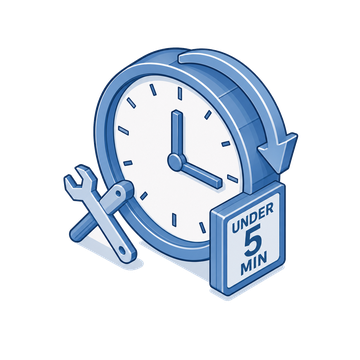
Single or Gang Pick VOB 2.0 Vacuum On Board JLS-Engineered
Recipe-driven changeover icon
Recipe-Driven · Application-Dependent

Recipe-driven changeover

Select the new recipe on the HMI and complete the application-specific changeover steps, which may include tooling or guide adjustments. Current Hawk end-of-arm tooling is designed for tool-free change by hand. Purchased, validated SKUs are loaded before the system ships; changeover time depends on the application and which components change.

Recipe-Driven SKU Swap Validated Recipes Loaded
Configurable throughput icon
Configured to Your Application

Rate matched to your pack pattern

The Hawk handles up to 220+ cartons (products) per minute. The completed-case rate — up to 60 cases per minute — depends on how many products go into each case, the pack pattern, package dimensions, and case configuration, and the cell can load up to four cases per cycle depending on configuration. The cell layout is set during system design to fit your line.

Up to 220+ cartons/min Case Rate by Pack Count
In-house programming and HMI icon
York, PA · Designed & Programmed In-House

Operator HMI & in-house controls programming

Touchscreen interface designed for plant-floor operators — normal production operation and recipe selection don’t require an engineer or robot-programming expertise, while trained maintenance staff handle troubleshooting and upkeep. JLS engineers the controls and HMI programming in York, PA, on commercially available B&R hardware. After installation, JLS’s in-house support team has direct access to JLS engineering and programming expertise.

Programmed In-House by JLS ERP/MES Integration Available

Options & Add-Ons

More ways to fit your line.

Product stacking, grouping and shingling

Pack patterns

Pack patterns and case arrangements are engineered to the application and managed through the product recipe where applicable.

Engineered
To your
application
Confirmed
During application
review
Recipe
Managed where
applicable
Integrated cleanable infeed icon
Integrated Cleanable Infeed
JLS coordinates cleanable infeed conveyors that present product cleanly and consistently to the robot arm — the steady, even, repeatable supply that the Hawk's fixed pick-and-place depends on.
Enhanced washdown options icon
Higher-sanitation areas
The Hawk is built with IP65-rated components and a round-tube stainless steel frame for cleanable secondary-packaging areas. It isn’t offered as a high-pressure washdown machine — for those zones, JLS recommends its Osprey or Talon platforms.
Configure Your System
Need something specific?
Every Hawk is configured to your product, format, and facility. Talk to a JLS application engineer about your exact requirements.
Talk to an Engineer →

Flexible line integration

Robotic case packing for the line already on your floor.

Already have upstream packaging equipment in place? The Hawk is engineered to integrate with your current line after primary packaging, with compatibility determined by the application and agreed interfaces. JLS coordinates the mechanical interface, controls communication, and timing synchronization.

Need more than case packing? JLS also builds tray loading and cartoning systems, and coordinates the interfaces with third-party case erecting, sealing, and palletizing equipment.

Application Engineering & Integration

Configured for your product.
Scalable across your line.

No two food plants run the same — but every Hawk ships from the same proven platform. Our application engineers tailor VOB 2.0 tooling, infeed conveyors, and case handling to your exact product and packaging formats — whether you're running rigid packs, pouches, bakery, frozen foods, or snacks. One team, one facility, one integration.

Fits your line. Day one.

A compact robotic case packer built to handle standardized secondary packaging — cartons, trays, clamshells, canisters, and other rigid containers — continuously and accurately. The proprietary two-axis kinematic robot arm picks product with VOB 2.0 vacuum tooling and places it into the case in programmed patterns, handling up to 220+ cartons per minute, with completed-case rates that depend on products per case and configuration. Sensor-based detection, suited to uniform product presented consistently. Start with a single Hawk cell and add Hawk cells for capacity as your line grows.

UPSTREAM Primary packaging HAWK 2-AXIS ROBOT ARM CASE PACKER PER APPLICATION DOWNSTREAM · 3RD-PARTY Case closing & sealing OUTPUT Distribution
JLS + Reiser: Expertise across the line

Planning more than just case packing?

JLS engineers tray loading, case packing, and cartoning systems and coordinates the interfaces with third-party case erecting, sealing, and load-securement equipment — planned as one solution.

Full food production line — JLS + Reiser: expertise across the line Ten production-line stages across four zones. JLS-built robotic automation stages are shown in purple; stages available through Reiser's OEM portfolio in blue; customer-selected or partner equipment in gray. Dashed lines mark coordinated integration points. Prepare. Portion. Form. Load. Seal. Case. Carton. Collate. Stack. Secure. 01Mixing &blendingGrindingEmulsifyingMarinatingTumblingAvailable throughReiser portfolio 02Forming &portioningStuffingExtrudingPatty formingDepositingAvailable throughReiser portfolio 03FurtherprocessingSlicingDicingShreddingTenderizingAvailable throughReiser portfolio 04PrimaryloadingPick & placeVision-guidedLane loadingProduct collationJLS TALONJLS KESTRELJLS Automation 05PrimarypackagingThermoformingTray sealingVacuum / MAPSkin packAvailable throughReiser portfolio 06CasepackingRobotic case loadingRobotic loadingWashdown configurationsWashdown optionsJLS OSPREYHAWK · PATTY HAWKCase erecting & sealing via partner equip.JLS Automation 07CartoningForm, load,close cartonsCompact footprintWashdown-capable designJLS PEREGRINEPEREGRINE ISJLS Automation 08Collation /bundlingCount & stackBundle packMultipackPartner equipmentscope-dependent 09PalletizingLayer buildingRobotic palletizingSlip-sheet placeLayer padPartner equipmentscope-dependent 10LoadsecurementStretch wrapBandingCorner boardTop sheetPartner equipmentscope-dependent Tier 1 Primary Packaging The package that touches the product Tier 2 Secondary Packaging Cases, cartons, and multipacks for retail or distribution Tier 3 Tertiary Packaging Stretch wrap, ship-ready unit

Together, JLS and Reiser help food manufacturers develop coordinated processing and packaging lines—from product preparation and primary package loading and sealing through cartoning and case packing, with third-party collation, palletizing, and load securement coordinated into the plan.

Illustrative line architecture. Stages, equipment suppliers and sequence vary by product and project scope. Not every food line uses every stage, and slicing, cooking, freezing, inspection and other processes may occur in different positions.

Scroll left and right to scan the full line. Open the printable line map →

JLS-built robotic automation Available through Reiser’s OEM portfolio Customer-selected / third-party equipment Coordinated integration point

Reiser role across the line

Food-processing expertise, application development, equipment selection, product testing, and sales & lifecycle support.

JLS role at robotic packaging stages

Robotic engineering, product & package handling, controls interfaces, and integration & FAT when included in project scope.

Let’s talk more about planning your full line.

Tell us who you are and a bit about your line. An automation expert will reach out — and we’ll bring the right people from JLS and Reiser to the conversation.

Your details
Facility location
Your line today
What you're planning
What solution(s) are you interested in?* Select all that apply.
Project timeline

By submitting, you agree that JLS Automation and Robert Reiser & Co. may contact you about your inquiry.

They do what they say they’re going to do, and they perform. I would, in a heartbeat, recommend them to any processing facility.
John Buckley, Director of Operations Berks Packing · JLS Osprey Case Packing

Specs & Configuration

Hawk technical specifications.

Configuration snapshot

Hawk performance is described by two different measurements that run at the same time: how many products (cartons) the robot handles per minute, and how many completed cases leave the cell per minute. The relationship depends on products per case, pack pattern, package dimensions, and case configuration — for example, a recipe packing more products per case runs fewer cases per minute at the same carton rate.

Product / carton handling rate
Up to 220+ cartons/min*
Products picked and placed per minute, by configuration.
Completed case rate
Up to 60 cases/min*
Filled cases per minute — set by products per case and pack pattern.
Your product
Validated rate*
JLS Flight Lab establishes feasibility where testing fits the project; rate and performance are validated at FAT, with final confirmation at commissioning where upstream conditions can’t be simulated.

*Estimated rates vary by product, tooling, and configuration. JLS confirms the right configuration for your product and target rate during a line assessment.

Specification Value
Estimated Throughput Product handling: up to 220+ cartons/min. Completed cases: up to 60 cases/min. Case rate depends on products per case, pack pattern, and configuration; can load up to 4 cases per cycle depending on configuration*
Robot Heads Single-head robot arm; cell layout configured to the application
Robot Type Proprietary two-axis kinematic robot arm; IP65-rated
End-of-Arm Tooling VOB 2.0 Vacuum On Board tooling (single- or gang-pick), with mechanical elements where the pack pattern requires; selected during system design
Product Size Wide range — confirmed per application (cartons, trays, clamshells, canisters, and other rigid containers)
Loading Styles Single, stacked (vertical), or shingled — primarily into cases; display-tray and other container formats confirmed per application
Vision System Fixed pick-and-place logic
Control System B&R Automation
Construction Level Cleanable construction for secondary-packaging areas; IP65-rated components (a component enclosure rating, not a sanitation level)
Sanitation Cleanable stainless steel construction; IP65-rated components
Frame Construction Round-tube stainless steel frame (standard) with sloped surfaces
Estimated Footprint (excl. guards) Varies by configuration — contact JLS for footprint and customization options
Electrical Supply 480V ±10%, 3-phase, 60Hz
Air Supply 80 PSI, clean, dry, lube-free
Electrical Enclosures Control enclosures rated for the application; UL/cUL listed
Reliability Factory acceptance tested (FAT) before shipment; where upstream rates can’t be simulated at FAT, final rate validation is completed at commissioning
Lead Time Target delivery established at proposal

*Estimated rates vary by product, tooling, and configuration; Specifications may vary by configuration — contact JLS for your specific application.

Where should we send it?

What solution(s) are you interested in? (optional) Select all that apply.

By submitting, you agree that JLS Automation and Robert Reiser & Co. may contact you about your inquiry.

Compare

Where the Hawk fits.

Application need Hawk Osprey family
Robot and guidance Proprietary 2-axis kinematic robot arm; sensor-based, non-vision pick-and-place Delta robots with application-matched 2D or 3D vision
Best-fit presentation Repeatable, controlled product and package presentation More variation in product position and presentation
Typical packages Cartons, trays, clamshells, canisters, and other rigid containers Sealed trays, chubs, bags, pouches, and thermoformed packs
Throughput Up to 220+ cartons/min handled; case rate depends on products per case* Up to 180 trays/min (TL, Tri Head) or 240 chubs/min (CL); BP confirmed per application*
Sanitation Cleanable construction with IP65*-rated components for drier secondary-packaging areas Cleanable construction; higher-sanitation options per application
Controls and support Programmed by JLS on the B&R controls platform; JLS support team Programmed by JLS on the B&R controls platform; JLS support team

Two different tools for different application needs — JLS recommends the platform that fits your product and line. *Rates are application-dependent and vary by product, tooling, pack pattern, and configuration.

Case Packing Application Example · JLS Hawk Robotic Case Packer

Two Hawk case packers, refurbished and retooled for a new product mix.

A long-standing JLS customer — a Fortune 500 food manufacturer — had two existing Hawk case packing systems on the floor. As its product mix evolved, the machines needed retooling for a new format. Instead of buying new, the customer chose JLS Aftermarket to extend the life of equipment already proven in its plant.

JLS disassembled, cleaned, retooled, re-validated, and re-commissioned both Hawks — new end-of-arm tooling for the new pack format, recipe development, full controls validation, and updated documentation, with 16 recipes programmed on each machine. Both systems passed a rigorous four-day customer Factory Acceptance Test in York, PA, including full wire tracing, fault testing, and a comprehensive HMI review, with only minor punch-list items before shipment. The customer has since expanded into additional JLS projects across more production lines.

Read the full story on the JLS case studies page.

Get the full case study

See the configuration, throughput, and results behind this install.

Tell us more about your challenge

By submitting, you agree that JLS Automation and Robert Reiser & Co. may contact you about your inquiry.

Questions about this application? Talk to an expert →

Hawk case packer FAQs.

Common questions about Hawk formats, throughput, tooling, sanitation, integration, testing, and ROI.

The Hawk is a robotic case packer built around JLS's proprietary two-axis kinematic robot arm for secondary case packing. The Hawk uses sensor-based, fixed-position pick-and-place on a standardized, consistent infeed — mechanically simple, with no vision system to calibrate or maintain. It handles up to 220+ cartons per minute, with completed-case rates that depend on products per case and configuration, and automates repetitive case-packing tasks that have become increasingly difficult to staff.

The Hawk is cleanable construction with IP65-rated components, suited to drier secondary-packaging environments — a round-tube stainless steel frame with sloped surfaces. IP65 is a component enclosure rating, not a sanitation level, and the Hawk isn't offered as a high-pressure washdown machine; where an application needs higher sanitation, JLS recommends its Osprey or Talon platforms. Your JLS representative will confirm the right construction for your environment.

The Hawk automates repetitive case-packing tasks that have become increasingly difficult to staff, so people can move to higher-value work on the line. The impact depends on line speed, shift schedule, and current staffing. Across JLS automation projects, payback is typically evaluated in the 24–36 month range, depending on the line; JLS reviews the business case for your specific Hawk application during a line assessment.

Payback depends on labor cost, shift schedule, line speed, and pack pattern. Across JLS automation projects, payback is typically evaluated in the 24–36 month range; a Hawk-specific figure depends on your line. ROI is driven by labor savings, reduced product damage from inconsistent packing, lower workers' comp costs, and decreased turnover-related training expense. JLS provides an engineering-led line assessment and can help you frame the ROI case for your operation.

The Hawk is built on a proprietary two-axis kinematic robot arm with sensor-based, non-vision pick-and-place — mechanically simpler and well suited to consistently presented cartons, trays, clamshells, canisters, and other semi-rigid or rigid packages. The Osprey is JLS’s vision-guided family of delta-robot case packers, with application-matched 2D or 3D vision on every system, for sealed trays, chubs, bags, pouches, and thermoformed packs where presentation varies more. Both use JLS-engineered VOB 2.0 tooling, and both are programmed by JLS on the B&R controls platform. JLS engineers recommend the right system based on your product and line requirements.

Changeover on the Hawk is recipe-driven and application-dependent — actual time depends on the application and which components change. Operators select the new product recipe on the HMI touchscreen, with no programming required, and complete any application-specific steps; current Hawk end-of-arm tooling is designed for tool-free change by hand. Purchased, validated SKUs are pre-loaded during commissioning before the system ships.

The Hawk case packs cartons, trays, clamshells, canisters, and other rigid containers presented on a standardized, consistent infeed, across bakery, frozen, snack, and other packaged food lines. Formats are confirmed per application.

Yes, in most applications. The Hawk runs after primary packaging and cartoning equipment, including Reiser lines, with compatibility determined by the application and agreed interfaces. JLS application engineers coordinate the mechanical interface, controls communication, and timing synchronization within JLS’s defined scope.

The Hawk is designed for food plants from the start, with cleanable stainless steel construction and IP65-rated components rather than retrofitted guarding. Sensor-based, fixed-position pick-and-place keeps the system mechanically simple for consistently presented product flows. JLS-engineered VOB 2.0 tooling is configured to your package, and the system is engineered and programmed in-house by JLS on the B&R controls platform.

Installation timelines vary by project scope and are confirmed during the proposal process. Pre-commissioning, including factory acceptance testing at JLS's facility, is completed before the system ships, so on-site time is focused on integration and operator training.

The Hawk is engineered and assembled at JLS Automation's facility in York, Pennsylvania. JLS engineering, programming, assembly, testing, and integration are done under one roof, using commercially available robot, motion, and controls components. Post-installation support comes from JLS’s in-house support team, with direct access to JLS engineering and programming expertise: remote diagnostics, on-site service, and preventive maintenance programs.

Often, yes. JLS Flight Lab in York, PA can test product samples, or a close proxy, subject to scope and availability, to establish tooling, pick method, and pack pattern feasibility before the design is finalized, reducing project risk. Rate and performance are validated during the project FAT, with final confirmation at commissioning where upstream conditions can’t be simulated.

To scope a Hawk, JLS typically reviews your product type and dimensions, photos or video of the current line, secondary container format, target speeds, SKU mix, labor model, sanitation requirements, available floor space, and the main production problem to solve.

Still have a question that isn’t answered here?

What do you want to know?

Ask us anything — an automation expert will follow up.

What can we help with? Optional — select any that apply.

By submitting, you agree that JLS Automation and Robert Reiser & Co. may contact you about your inquiry.

Talk to an automation expert

Have a product you need packed with the Hawk?

Tell us what you’re packaging and what you’re trying to solve. A few sentences is enough.

Prefer to talk? Call (717) 505-3800.

By submitting, you agree that JLS Automation may contact you about your inquiry. See our privacy policy.

* The Hawk uses IP65-rated components in cleanable stainless steel construction. Contact your JLS representative for full details on your application.

Find out what your line is capable of.

We evaluate your line, your product, and your constraints — then show you what will work, what won't, and what to weigh in your ROI case. No guesswork. No force-fitting.

Over 1,000 installations. Predictable, fast performance. Premier, dedicated service.

  • Fast response times (remote + on-site)
  • Experienced JLS technicians
  • Spare parts & lifecycle support
  • Training that sticks with your operators
Have a product you need loaded, packed or cartoned?
Start with whether it’s a fit — not with a quote.
Tell an application engineer what you’re packaging and what the line looks like today. A few sentences is enough. If the product suits it, JLS can test it in the Flight Lab before any design is finalized.
Already running a JLS line?
Connect with the service experts who keep your automation performing.
Spare parts, preventive maintenance, retooling, training, and on-site support — from JLS's in-house support team, backed by direct access to JLS engineering and controls expertise.