/JLS%C2%AE_MasterLogo_Navy.png)
 B&R Controls: Why JLS Programs Everything In-House">
When something goes wrong on a packaging line — a timing fault, a recipe error, a communication dropout between the case packer and the palletizer — the first question is always: whose controls are we looking at?
If your case erector runs on one PLC platform, your case packer runs on another, and your palletizer runs on a third, the answer to that question gets complicated fast. Three vendors. Three programming environments. Three support numbers. And nobody who owns the integration between them.
JLS took a different approach.
One platform
Every JLS machine — across the TALON®, OSPREY®, HAWK®, PEREGRINE®, Patty Hawk, Harrier, and Kestrel™ product families — runs on commercially available B&R Automation technology. One controls platform. One programming environment. One network architecture.
This isn't a recent decision or a marketing alignment. JLS selected B&R as its standard controls platform and has built its machines on it since. The choice was driven by B&R's real-time performance and its capability to handle the multi-axis motion control that food packaging robots require.
But the platform decision is only half the story. The other half — the part that matters most to customers — is that JLS programs and supports the application controls in-house.
In-house application programming
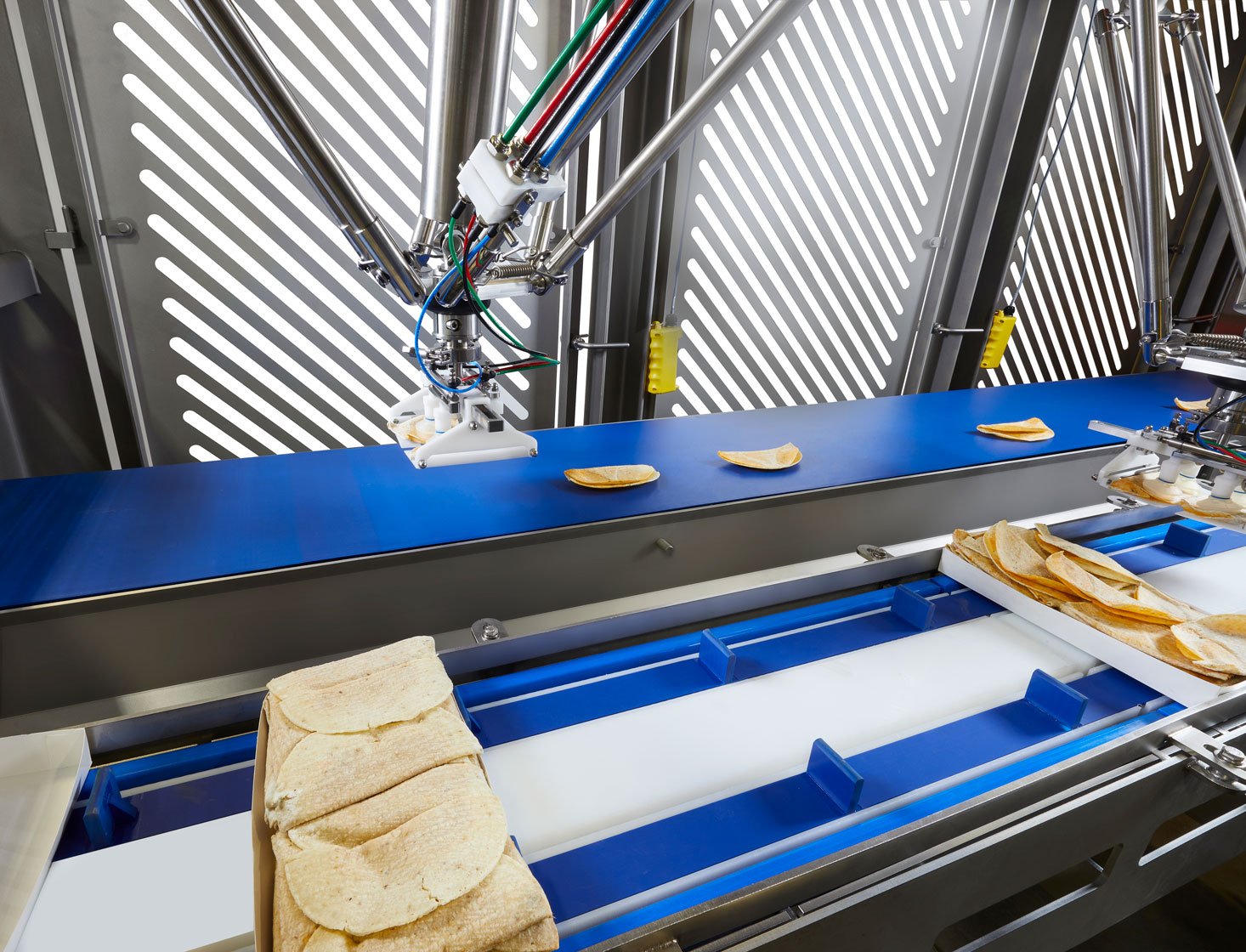
The application software that runs a JLS machine is written by JLS controls engineers in York, Pennsylvania, on commercially available B&R technology. The robot motion profiles, the vision system integration, the recipe management, the HMI screens, the communication interfaces to upstream and downstream equipment — all programmed internally.
JLS doesn't outsource application programming to third-party integrators, and it doesn't rely on generic software packages that get configured on-site. The application controls are as purpose-built as the mechanical hardware.
This matters for three practical reasons.
1. Coordinated multi-machine integration
When a customer's line includes multiple JLS machines — say, a Talon primary handling cell feeding an Osprey case packer — those machines share the same B&R controls architecture and the same programming conventions. The timing, the handshakes, the fault handling — all designed as one integrated system, not two separate systems bolted together.
Equipment such as case erectors, sealers, and palletizers is typically selected partner equipment, and JLS coordinates the controls interfaces defined for the project — so the communication between the JLS scope and the surrounding equipment is engineered and tested rather than left as an open question between vendors.
For the customer, this means one controls interface for the JLS scope: one HMI to operate, one set of diagnostic screens for troubleshooting, and one recipe system for the JLS equipment on the line.
2. Recipe-based changeover
JLS machines use recipe-driven changeover from the HMI. Select the new product, and the system adjusts robot motion profiles, vision system parameters, case dimensions, collation patterns, and timing across the JLS equipment on the line.
This works because the application controls are programmed in-house on a single platform. When the recipe system needs to coordinate a changeover across a case packer and a vision-guided robot cell, it's all running in the same programming environment, on the same network, with the same data structures.
Outsourced programming can deliver recipe-based changeover on a single machine. Coordinating recipe-based changeover across multiple machines from different vendors, on different platforms, with different programming conventions — that's where the complexity explodes and changeover times multiply.
3. JLS View remote visual assistance
When a JLS machine needs support, JLS View provides remote visual assistance: plant personnel connect with the JLS support team — backed by the engineers who built the system — using wearable and mobile technology, so support can see what the person at the machine sees, walk through diagnostics in real time, and help resolve issues without waiting for a technician to travel to the plant.
This capability is stronger because JLS programs the application controls. When a third-party integrator programs your machine, support means calling the integrator, waiting for availability, and hoping they remember the specifics of your installation. When the OEM programs the application, support comes from a team with full knowledge of the software, the hardware it runs on, and the parameters in your system.
Why it matters to operations
For an operations manager or plant engineer, the controls architecture of your packaging line isn't an abstract technical decision. It determines:
- How fast you change over between products (one recipe command vs. multiple system adjustments)
- How quickly issues get resolved (one support call vs. a multi-vendor troubleshooting session)
- How well machines work together (shared platform and engineered interfaces vs. loosely connected separate systems)
- How maintainable the system is long-term (in-house documentation and support vs. third-party dependency)
JLS's decision to standardize on commercially available B&R technology and program the application controls in-house is a decision to own its controls scope — so customers deal with one controls partner for the JLS equipment on their line.
Ask JLS About Controls Integration for Your Line
JLS Automation designs, programs, and builds robotic packaging systems on commercially available B&R Automation technology at its facility in York, Pennsylvania. To discuss your packaging line integration, visit jlsautomation.com or call +1 (717) 505-3800.
What do you want to know?
By submitting, you agree that JLS Automation and Robert Reiser & Co. may contact you about your inquiry.
Reviewed by
JLS Automation Engineering — York, PA
See it run on your product.
Bring us your product. We'll test it in our York, PA lab and prove the automation before you commit.
Schedule a facility tour