/JLS%C2%AE_MasterLogo_Navy.png)
 Collate and Load: How Robotic Collation Eliminates a Manual Bottleneck">
Before a cylindrical product reaches its package, it needs to be organized. Snack sticks arrive in bulk. Sausages tumble off upstream equipment in no particular order. Before a thermoformer can seal them, someone — or something — has to separate them, align them, and place them into pockets in the right count and orientation.
In many protein operations, that step is where automation stops and manual labor starts.
The thermoformer runs at a continuous pace. The upstream process produces at rate. But the step in between — organizing bulk cylindrical product into loaded pockets — is often done by a row of workers placing sticks by hand, shift after shift.
It's a bottleneck that limits throughput, depends on labor availability, and introduces variability that cascades downstream.
Why This Step Stays Manual
Cylindrical products are genuinely hard to automate. They roll. They cluster. They arrive in unpredictable orientations. Conveyor systems built on rails and lane dividers jam, tumble product, and demand constant attention.
So operations default to manual loading, because people are flexible. Workers can handle the variation. The tradeoff is that manual loading can't match the thermoformer's pace — the machine waits on the people, and the line runs at manual speed.
What the Kestrel Changes
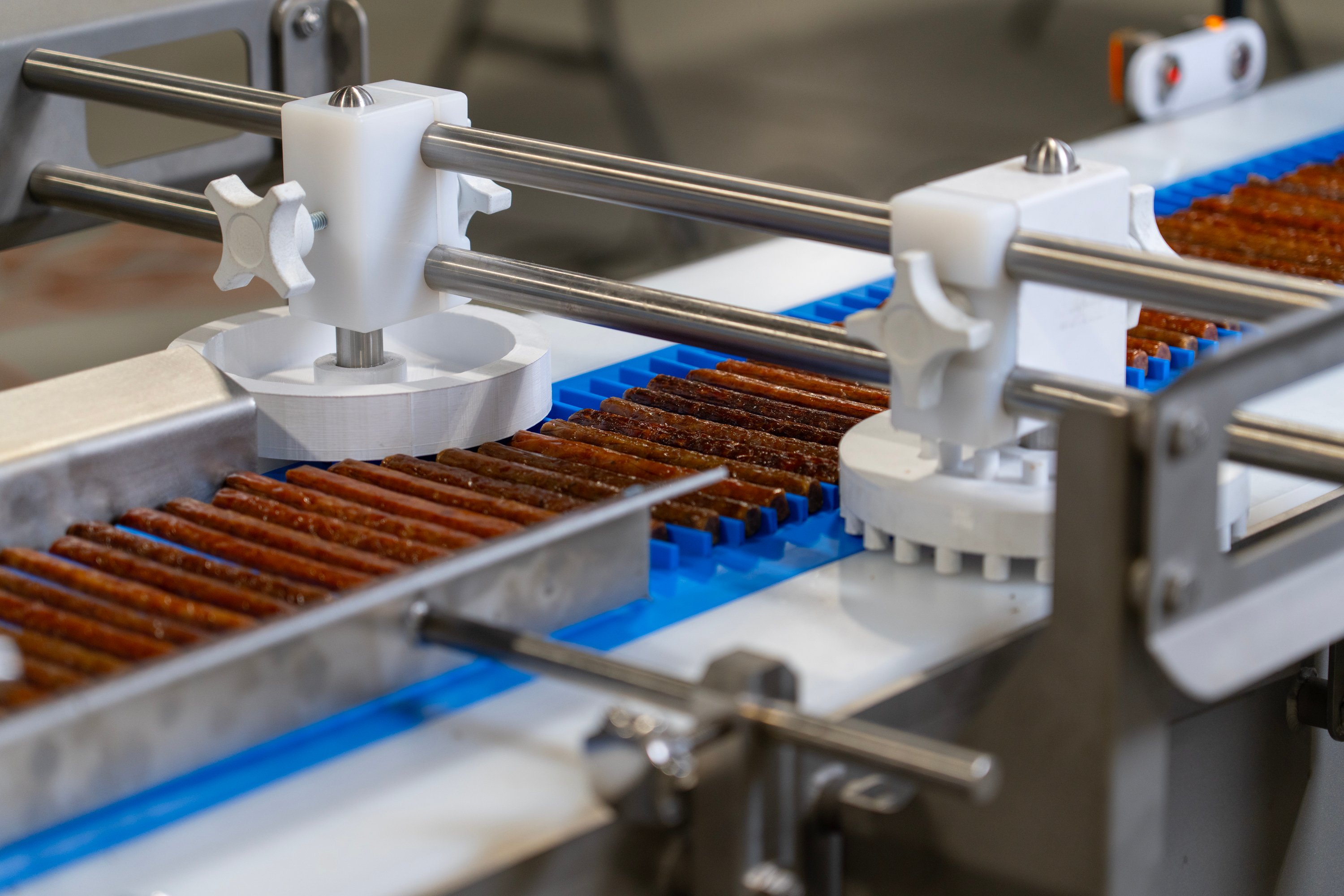
The Kestrel organizes uniform cylindrical products from bulk presentation and loads them into thermoformer pockets. It combines centrifugal singulation, a collation conveyor, and non-vision robotic gang-pick loading — in one system.
High-speed centrifugal singulation moves product from bulk to single-file presentation without the rails and lane dividers that cause tumbling and jams. A custom collation conveyor aligns the product into rows. A washdown-capable delta robot then gang-picks multiple products per cycle and loads the thermoformer — normally placing one product into each pocket, with the loading pattern configured to the product and package.
Because the feeder and collation conveyor organize the product mechanically, the system doesn't depend on camera-based vision — which simplifies the system and reduces sensitivity to product color or surface variation. A small stylist crew remains on the line for product presentation.
The Labor and Throughput Math
Count the people hand-loading your thermoformer today, across all shifts, and multiply by your fully loaded labor cost — wages, benefits, overtime, turnover, and training. For most operations running cylindrical products, that number justifies the conversation on its own.
But throughput often matters more. Manual loading caps line speed at the pace of the crew. The Kestrel runs at up to 600 products per minute in a single-head configuration, depending on product and package type — consistently, across every shift.
What Products Fit
The Kestrel is engineered for uniform cylindrical products:
- Snack sticks and meat sticks
- Straight sausages, franks, and hot dogs
- String cheese and similar cylindrical formats
If your product is a uniform cylinder headed for a thermoformer or similar primary package, it's a Kestrel conversation. If it isn't, JLS has other platforms shaped around other products — that's what an application review is for.
Where Kestrel Fits in the Line
The Kestrel sits between your upstream process and your thermoformer, replacing the manual loading crew's separation and placement work with one continuous automated flow: bulk infeed, singulation, collation, robotic loading. It runs on the same B&R controls platform as the rest of the JLS line, with recipe-driven changeover from the HMI.
If your thermoformer is waiting on hand-loading, the bottleneck has a solution.
The Kestrel collate-and-load system is designed and built by JLS Automation in York, Pennsylvania. To discuss your application, visit jlsautomation.com/kestrel or call +1 (717) 505-3800.
What do you want to know?
By submitting, you agree that JLS Automation and Robert Reiser & Co. may contact you about your inquiry.
Reviewed by
JLS Automation Engineering — York, PA
See it run on your product.
Bring us your product. We'll test it in our York, PA lab and prove the automation before you commit.
Schedule a facility tour