/JLS%C2%AE_MasterLogo_Navy.png)
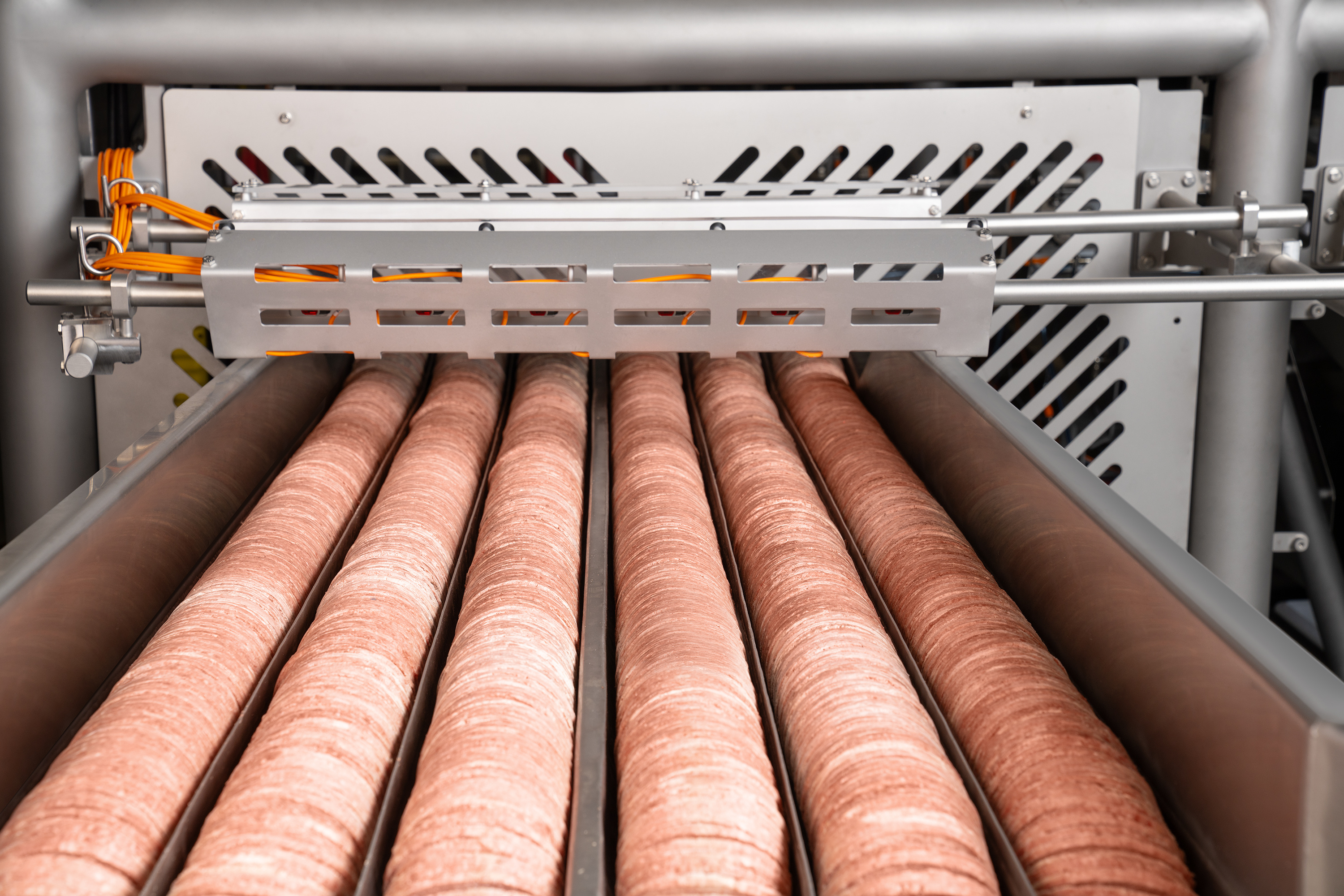 From Forming to Freezing to Packing: Automating the Complete Patty Line">
Most frozen patty producers don't have a packing problem. They have a line balance problem.
The former runs at rated speed. The freezer processes product at a fixed rate determined by belt speed, tunnel length, and temperature. The stacker and wrapper output finished patty stacks at a pace set by the upstream equipment. Then everything arrives at the case packing station — and a crew of workers in a freezer environment tries to keep up.
Sound familiar? It's the same bottleneck pattern that exists in chub packing, tray packing, and pouch packing operations. The automated steps run fast. The manual step can't match the pace. The entire line runs at the speed of the slowest station.
Here's what it looks like when the full patty line runs in balance.
Stage 1: Forming
The line starts with your patty former — whichever brand and format you run. The former outputs individual patties onto a discharge conveyor at production speed.
JLS reviews the existing equipment, transfer points, and controls interfaces when planning the line — the integration is engineered around your former, not the other way around.
Stage 2: Freezing
Formed patties move into the spiral or tunnel freezer. Freezing requirements depend on the product and the selected freezer — patty thickness, composition, and target core temperature all factor in.
The freezer is the pacemaker of the line. Everything downstream needs to be designed to handle the freezer's output rate. If your packing station can't consume product at the rate the freezer discharges it, you're either accumulating frozen product (which creates storage costs and quality degradation) or throttling the freezer (which wastes capacity).
Stage 3: Stacking and Wrapping
Frozen patties are stacked and prepared for packing. Product presentation, stack count, and any interleaving or wrapping are specified for the application — retail and foodservice formats each have their own requirements.
The output of this stage is finished patty stacks on a conveyor, heading toward case packing.
Stage 4: Robotic Case Packing
This is where the Patty Hawk replaces the manual packing crew. The system picks frozen patty stacks from the infeed conveyor and places them into cases with the precision needed to protect the stack during transport.
The Patty Hawk handles validated retail and foodservice stack formats — different diameters, heights, and stack counts — with recipe-based changeover from the HMI. When you switch between validated SKUs, the system adjusts without mechanical rebuilds.
Throughput is sized to your freezer and stacker output during system design. The bottleneck moves from packing to wherever you want it — and it's no longer your people standing in a freezer.
Stage 5: Case Sealing and Palletizing
Loaded cases discharge from the Patty Hawk to your case sealer and palletizer — third-party equipment that JLS coordinates as part of the line design. Because JLS builds on the B&R Automation controls platform — the same platform used across the Talon, Osprey, Hawk, and Peregrine product families — the controls interfaces with downstream equipment are defined and coordinated as part of the project.
The Line Balance Payoff
When case packing runs at the same speed as your freezer output, the entire line operates in balance. You stop accumulating frozen product between the freezer and the packing station. You stop throttling the freezer because your packers can't keep up. And you stop rotating workers through a freezer environment to sustain throughput.
For a frozen patty producer running multiple shifts, the line balance gain is often more valuable than the direct labor savings. You're not just removing workers from the packing station — you're unlocking the capacity that your former and freezer were designed to deliver.
One Integration Scope
JLS coordinates the full scope: mechanical interfaces with your existing former, freezer, stacker, and palletizer; controls communication across the line; concept design, system engineering, factory acceptance testing at JLS's facility in York, Pennsylvania; and installation support at your plant.
One accountable lead. One controls platform for the JLS scope. One conversation from forming to palletizing.
If your frozen patty line runs out of balance at the packing station, it starts with a conversation about your specific products, speeds, and facility layout.
JLS Automation designs and builds integrated robotic packaging systems in York, Pennsylvania. To discuss your frozen patty packaging line, visit jlsautomation.com/patty-hawk or call +1 (717) 505-3800.
What do you want to know?
By submitting, you agree that JLS Automation and Robert Reiser & Co. may contact you about your inquiry.
Reviewed by
JLS Automation Engineering — York, PA
See it run on your product.
Bring us your product. We'll test it in our York, PA lab and prove the automation before you commit.
Schedule a facility tour