/JLS%C2%AE_MasterLogo_Navy.png)
 Planning a Compact Case Packer for a Fresh-Produce Line">
Consider a produce processor planning to automate case packing on an existing blueberry-clamshell line. The first challenge usually isn't throughput, and it isn't product handling. It's floor space.
The line is running. The building isn't getting bigger. And the space between the clamshell sealer and the palletizer is exactly what it is — a fixed gap that every piece of new equipment has to fit into.
This is a common scenario in produce packing facilities. Plants are built around existing workflow. Adding automation means working within the footprint you have, not the footprint you wish you had.
The Space Problem
Most conventional case packers for rigid containers require a significant footprint. The infeed section, collation area, loading mechanism, and discharge conveyor add up to a machine that's 15 to 20 feet long and 6 to 8 feet wide — before you account for access clearance on both sides for maintenance and sanitation.
In a greenfield facility, that footprint is designed into the layout from the start. In an existing plant — where the sealer, inspection equipment, labeler, and palletizer are already in place — fitting a conventional case packer often requires moving upstream or downstream equipment, rerouting conveyors, or in some cases, modifying the facility itself. Those are capital projects on top of the automation investment.
For many operations, none of those options are on the table. The automation has to fit the available space or the project doesn't happen.
How the Hawk Fits
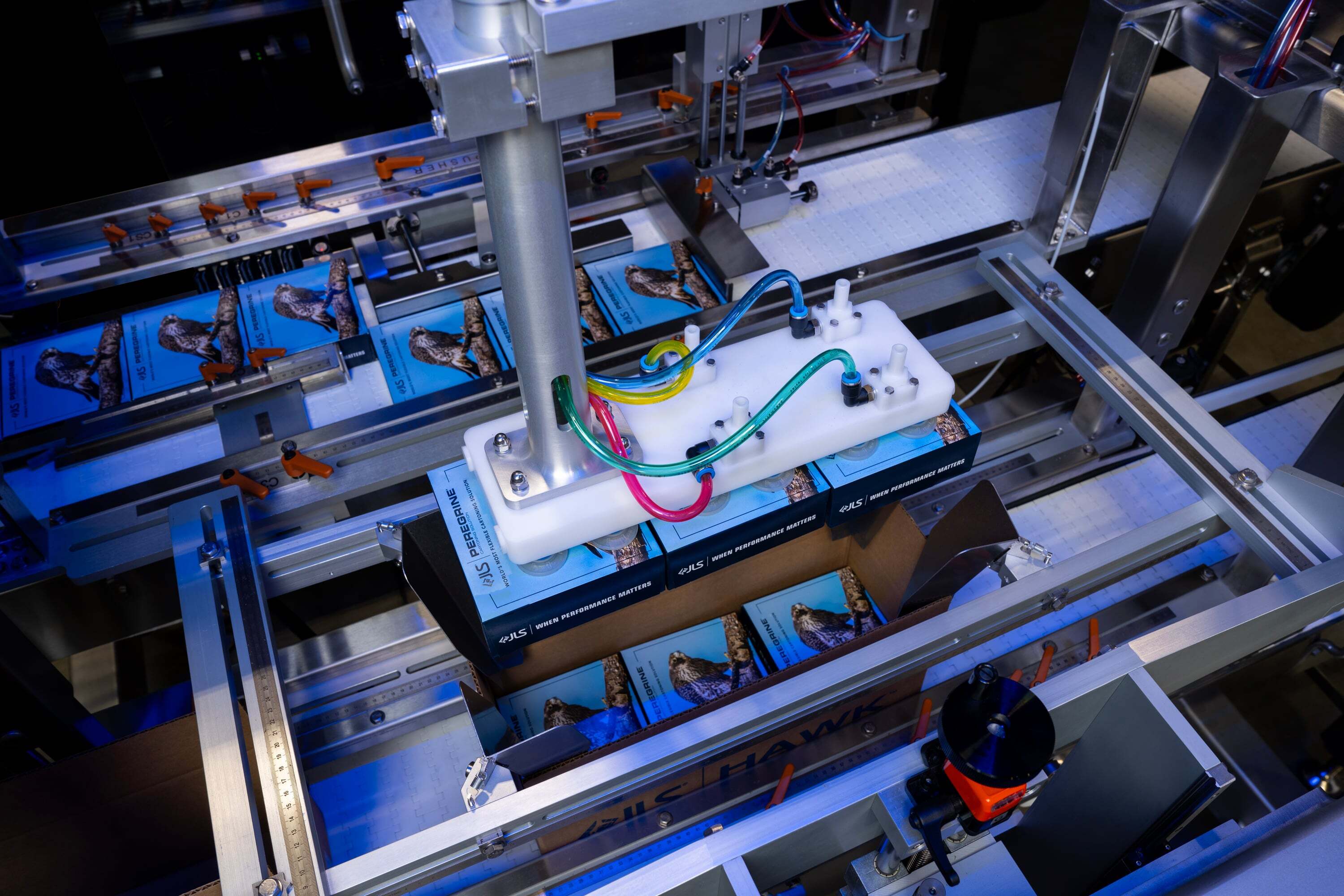
The Hawk case packer is built around a proprietary two-axis kinematic robot arm, which reduces the machine's footprint compared to conventional case packers. Supporting the loading mechanism from one side eliminates the need for a full frame structure around the entire case-loading area, and keeps maintenance and sanitation access on the open side.
In a space-constrained plan like the blueberry example, that compact architecture is what lets the case packer drop into the gap between the existing sealer and the palletizer infeed — without moving the sealer, rerouting conveyors, or modifying the facility. Actual footprint savings depend on the configuration and the equipment being compared; JLS provides layout drawings during the proposal so you can verify the fit against your real floor plan before committing.
The Application
Blueberry clamshells are a representative rigid container format: lightweight, uniform, and produced at high volume during peak season. In an application like this, the Hawk collates clamshells into the case-pack pattern on the infeed conveyor and loads the complete group into the case in a single motion.
Standard retail clamshell formats — such as 6-oz, 11-oz, and 18-oz — are handled through the HMI recipe system: select the validated format, make the required guide adjustments, and the Hawk runs the new clamshell. Changeover requirements depend on the formats and tooling involved.
During peak harvest season, lines run extended shifts. The Hawk runs at the same throughput rate regardless of shift length — no fatigue degradation, no staffing gaps, no productivity drop-off in hour ten that you see with manual packing crews.
Beyond Produce
The same footprint advantage applies to other applications where floor space is constrained:
- Bakery: Carton and clamshell packing for fresh baked goods, where the case packer needs to fit between the packaging line and the shipping area
- Dairy: Yogurt cups and tub packing in facilities where refrigerated floor space is at a premium
- Snack foods: Rigid container packing in plants running multiple lines in shared floor space
The common thread isn't the product category — it's the facility constraint. When the available space is fixed and non-negotiable, the machine's footprint becomes a qualifying criterion, not just a spec line.
The Retrofit Reality
Most automation projects in the food industry aren't greenfield. They're retrofits into existing operations. The equipment needs to fit the plant, not the other way around.
The Hawk was designed with this reality in mind. Compact footprint. Single-side access for maintenance and sanitation. Recipe-driven changeover for operations running multiple validated SKUs. And cleanable stainless construction with NEMA 4X-rated control enclosures, matched to the application.
If floor space is the constraint standing between your operation and automated case packing, it's worth measuring the gap and having a conversation about what fits.
Discuss your floor space and application
The Hawk case packing system is designed and built by JLS Automation in York, Pennsylvania. To learn more, visit jlsautomation.com/hawk or call +1 (717) 505-3800.
What do you want to know?
By submitting, you agree that JLS Automation and Robert Reiser & Co. may contact you about your inquiry.
Reviewed by
JLS Automation Engineering — York, PA
See it run on your product.
Bring us your product. We'll test it in our York, PA lab and prove the automation before you commit.
Schedule a facility tour