/JLS%C2%AE_MasterLogo_Navy.png)
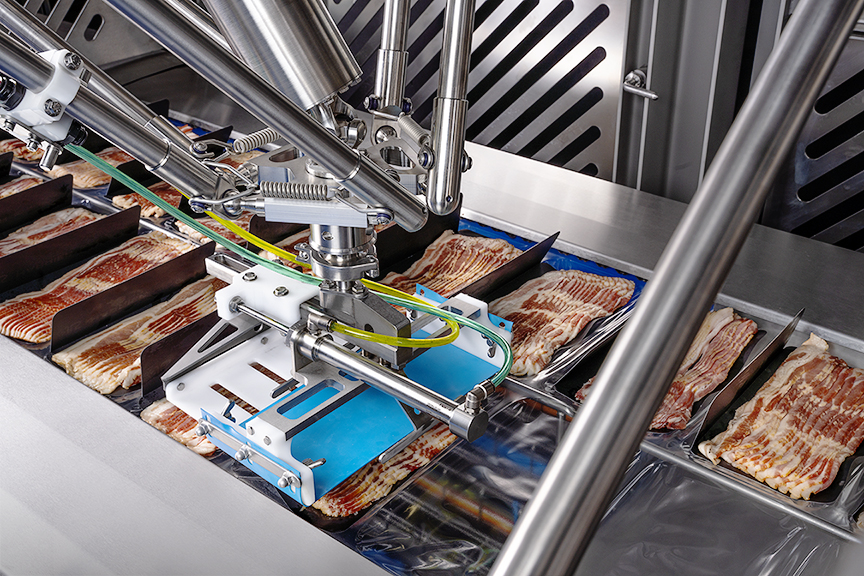 Inside the Patent-Pending Gripper That Folds and Loads Bacon Drafts Automatically">
Bacon packing has resisted automation longer than almost any other protein packaging application. The reason isn't throughput or hygiene — it's the product handling itself.
A bacon draft is a shingled arrangement of slices laid on a cardboard L-board. The L-board has a flap that folds over the top of the draft before the package enters the thermoformer for sealing. In manual operations, workers fold the flap, rotate the draft, and load it into the thermoformer pocket — by hand, hundreds of times per hour, across multiple shifts.
It's a sequence that requires folding, rotating, and placing a delicate product in a precise orientation. Standard pick-and-place robots weren't designed for this. JLS built a system that was.
The Handling Sequence
To understand why this is hard to automate, walk through what a manual packer does with each bacon draft:
- Pick up the L-board with the draft on it
- Fold the L-board flap over the top of the shingled bacon slices
- Rotate the draft 180 degrees to the correct loading orientation
- Lower the draft down into the thermoformer pocket — a cavity with precise dimensions that the draft must fit into without catching on the edges
- Release the draft cleanly so it settles into the pocket without disturbing the shingle pattern
A worker does this by feel. They adjust grip pressure based on the draft's weight, compensate for slight variations in shingle position, and angle the draft into the pocket with wrist movements that change subtly with each cycle.
Replicating that sequence with a robot requires purpose-built handling that can lift, fold, rotate, and release — all at production speed, all without damaging a product that has no structural rigidity.
The Patent-Pending Approach
The Harrier splits the job between two coordinated mechanisms. An air-cylinder-actuated servo finger beneath the conveyor tracks under the bacon and lifts the L-board flap. Mechanical, cylinder-actuated tooling on the robot then completes the fold, rotates the draft 180 degrees, and places the bacon draft into the thermoformer pocket.
Each of these motions is programmable for different draft sizes, L-board dimensions, and thermoformer pocket geometries. When you change products, the motion profile adjusts through the recipe system. No mechanical rebuilds. No manual gripper adjustments.
The vision system guides the sequence. Cameras identify each draft's exact position on the infeed conveyor, accommodating the natural variation in draft placement that comes from upstream slicing and shingling. The robot doesn't assume the draft is in a fixed position — it sees where the draft actually is and adjusts the pick accordingly.
Surge Capacity
Production lines don't run at a constant, perfectly uniform pace. Upstream slicers produce drafts in bursts. Line speeds fluctuate. Product gaps appear and close. A system that can only handle the average throughput rate will fall behind during surges and never recover.
The Harrier is designed with approximately 20% surge capacity above the nominal production rate. When drafts arrive in bursts from the upstream slicer, the system absorbs the surge without dropping product or creating backups.
This margin is engineered, not incidental. The robot speed, servo response times, and vision processing are all sized to handle peak throughput — not just average throughput.
Built for the Bacon Environment
Bacon packing happens in the food zone. The robot touches unpackaged product. The environment is wet, cold, and subject to aggressive washdown protocols.
The Harrier uses IP69K-rated delta robots — the same washdown standard as the Talon primary handling platform. Open-channel stainless construction with minimal harborage points. The system is designed to get wet — washed down every shift.
This isn't a retrofit of existing tooling. It's a purpose-built approach to a problem that kept bacon packing manual for decades — developed, tested, and proven on real bacon drafts before any system ships.
The Impact
For bacon producers running manual fold-and-load operations, the Harrier changes the economics of the thermoformer loading station. The manual packing crew — typically the largest labor concentration on a bacon line — is replaced by a system that runs at production speed across all shifts, without the ergonomic injuries, staffing challenges, and throughput variability that define manual operations.
The product handling precision is consistent — because the servo-controlled sequence applies the same fold, rotation, and placement trajectory on the thousandth cycle that it applied on the first.
The Harrier robotic bacon loading system is designed and built by JLS Automation in York, Pennsylvania. To discuss your bacon packaging application, visit jlsautomation.com/harrier or call +1 (717) 505-3800.
What do you want to know?
By submitting, you agree that JLS Automation and Robert Reiser & Co. may contact you about your inquiry.
Reviewed by
JLS Automation Engineering — York, PA
See it run on your product.
Bring us your product. We'll test it in our York, PA lab and prove the automation before you commit.
Schedule a facility tour