/JLS%C2%AE_MasterLogo_Navy.png)
 The Frozen Patty Packing Problem: Why Standard Case Packers Can't Handle Stacks">
Frozen patty stacks look simple. Uniform discs in neat columns — often with interleaving paper, a sleeve, or a bag, depending on the format. From a distance, they seem like easy products to automate.
They aren't.
Frozen patty stacks present a unique combination of challenges that standard case packers weren't designed to handle. The product is frozen, the stacks are fragile, and the placement requirements are precise. Getting all three right — at production speed — is why most patty producers are still packing by hand or running equipment that underperforms.
Challenge 1: Temperature
Frozen patties come off the freezer at freezer temperatures. Depending on the product and the operating environment, moisture on frozen product can create adhesion problems — stacks stick to surfaces they shouldn't stick to and slip on surfaces they should grip.
Standard case packing equipment is designed for ambient or refrigerated temperatures, not frozen. The materials, bearings, seals, and lubricants in a conventional case packer weren't selected for sustained operation at freezer temperatures. Performance degrades. Maintenance increases. Reliability drops.
Challenge 2: Stack Integrity
A frozen patty stack is not a monolithic unit. It's a column of individual patties — held together by its packaging or its own presentation, not by any inherent structural rigidity. Grip the stack too aggressively and you damage the product. Grip it too loosely and the stack separates during transport from the pick point to the case.
This is a fundamentally different handling problem than picking up a sealed tray or a rigid carton. A tray is a single solid unit. A patty stack is a loosely assembled column that can telescope, tilt, or collapse if not supported correctly throughout the entire pick-place-release cycle.
Standard pick-and-place systems use vacuum cups or mechanical clamps sized for the product's outer dimensions. Neither approach is optimized for a fragile stack that needs uniform support along its full height. Stack height, patty condition, product temperature, and package presentation determine the handling approach.
Challenge 3: Precise Placement
Frozen patty stacks are typically loaded upright into cases, in rows. The stacks need to be placed with enough precision that they hold their position during case transport and palletizing.
Unstable stacks can increase handling difficulty and product damage — which means damaged product, customer complaints, and rejected loads. The handling method must match the product and the operating environment.
Manual packers compensate for this with their hands and their eyes — they feel the stack settle into position and adjust in real time. Replicating that level of adaptive precision requires purpose-built tooling and control.
Purpose-Built for the Problem
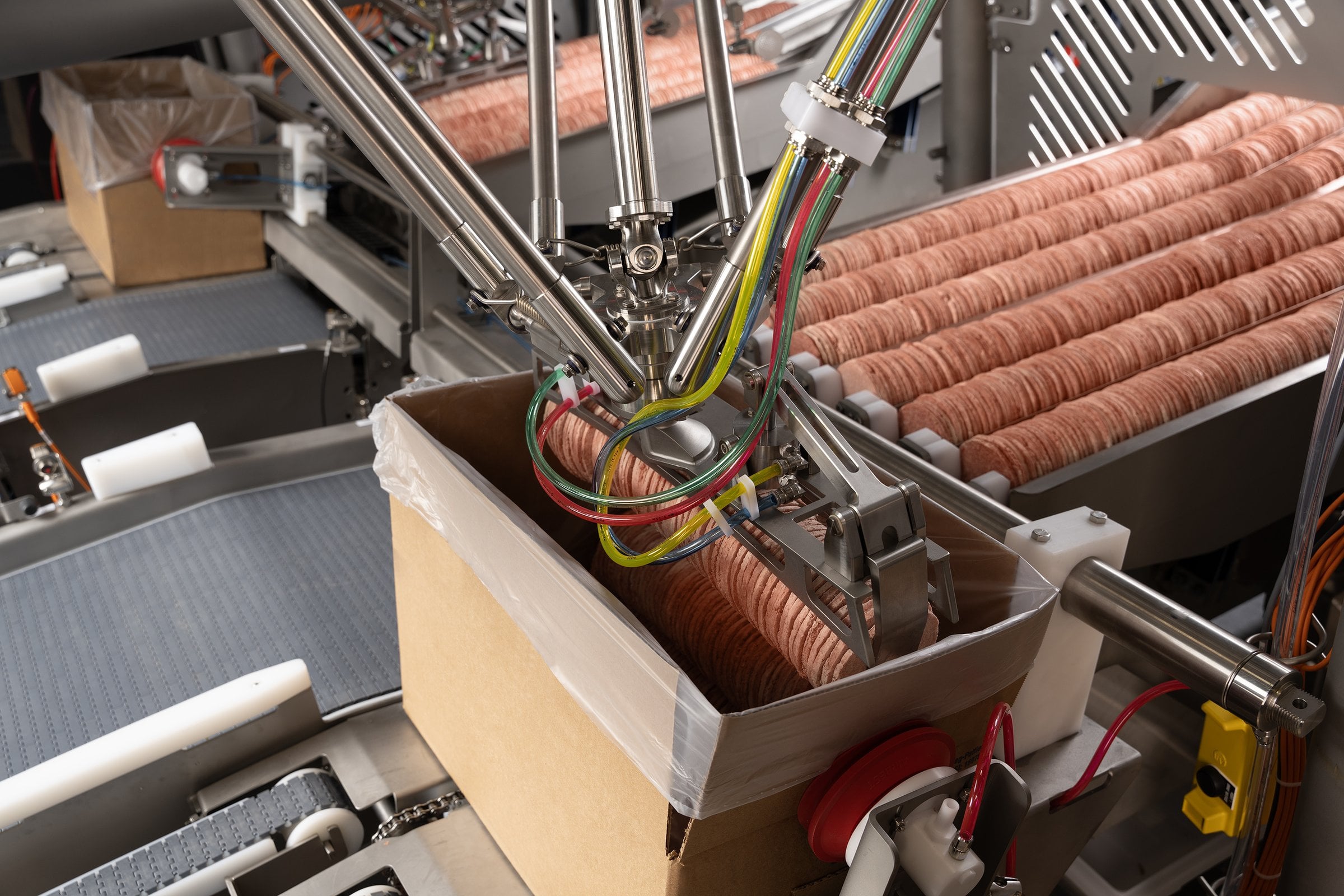
The Patty Hawk was engineered specifically for frozen patty stack case packing — not adapted from a machine designed for a different product category.
The system handles the temperature challenge with freezer-rated materials, bearings, and construction. The stack integrity challenge is addressed with tooling designed to support the stack during pick, transport, and placement. And the placement precision challenge is solved with controlled loading that positions each stack in the case with repeatable accuracy.
The Patty Hawk handles validated retail and foodservice stack formats, accommodating the range of diameters and stack heights common across beef, turkey, chicken, and plant-based patty production — with the specific counts and presentations configured per application.
The Manual Packing Reality
Most frozen patty operations still use manual case packing. Workers stand at the end of the freezer discharge line, pick up stacks, and place them into cases by hand — in a freezer environment, wearing heavy gloves that reduce dexterity, for entire shifts.
The physical demands are significant. Cold exposure, repetitive motion, and the precision required to place stacks cleanly create a job that's hard to staff, hard to sustain, and prone to injury. Turnover at manual frozen patty packing stations is among the highest of any position in meat processing.
When the math includes fully loaded labor costs, turnover, injury risk, and the throughput constraints of manual packing, the case for automation is clear. But the automation has to actually work for frozen stacks — not just for the product categories that are easier to handle.
That's why the Patty Hawk exists.
The Patty Hawk frozen patty case packing system is designed and built by JLS Automation in York, Pennsylvania. To discuss your frozen patty packing application, visit jlsautomation.com/patty-hawk or call +1 (717) 505-3800.
What do you want to know?
By submitting, you agree that JLS Automation and Robert Reiser & Co. may contact you about your inquiry.
Reviewed by
JLS Automation Engineering — York, PA
See it run on your product.
Bring us your product. We'll test it in our York, PA lab and prove the automation before you commit.
Schedule a facility tour